 TEL +86-13923172919
Rotary High Frequency Welding Machine: How Multi-Station Tables Maximize Output
A rotary high frequency welding machine does something no single-station machine can match. It welds, cools, loads, and unloads — all at the same time, at different stations on a spinning table.
The generator never waits. The press never sits idle. Output per shift climbs dramatically, without adding more floor space, more machines, or more operators.
This article explains how the multi-station turntable works, what it delivers over shuttle and push plate machines, which products benefit most, and what to look for when choosing one.
The Core Idea: Parallel Operations on a Single Machine
Every high frequency welding cycle has three stages: loading, welding, and unloading. On a push plate or shuttle machine, these stages happen in sequence. The machine idles while the operator loads. It idles again while the operator removes the finished part.
What the Turntable Changes
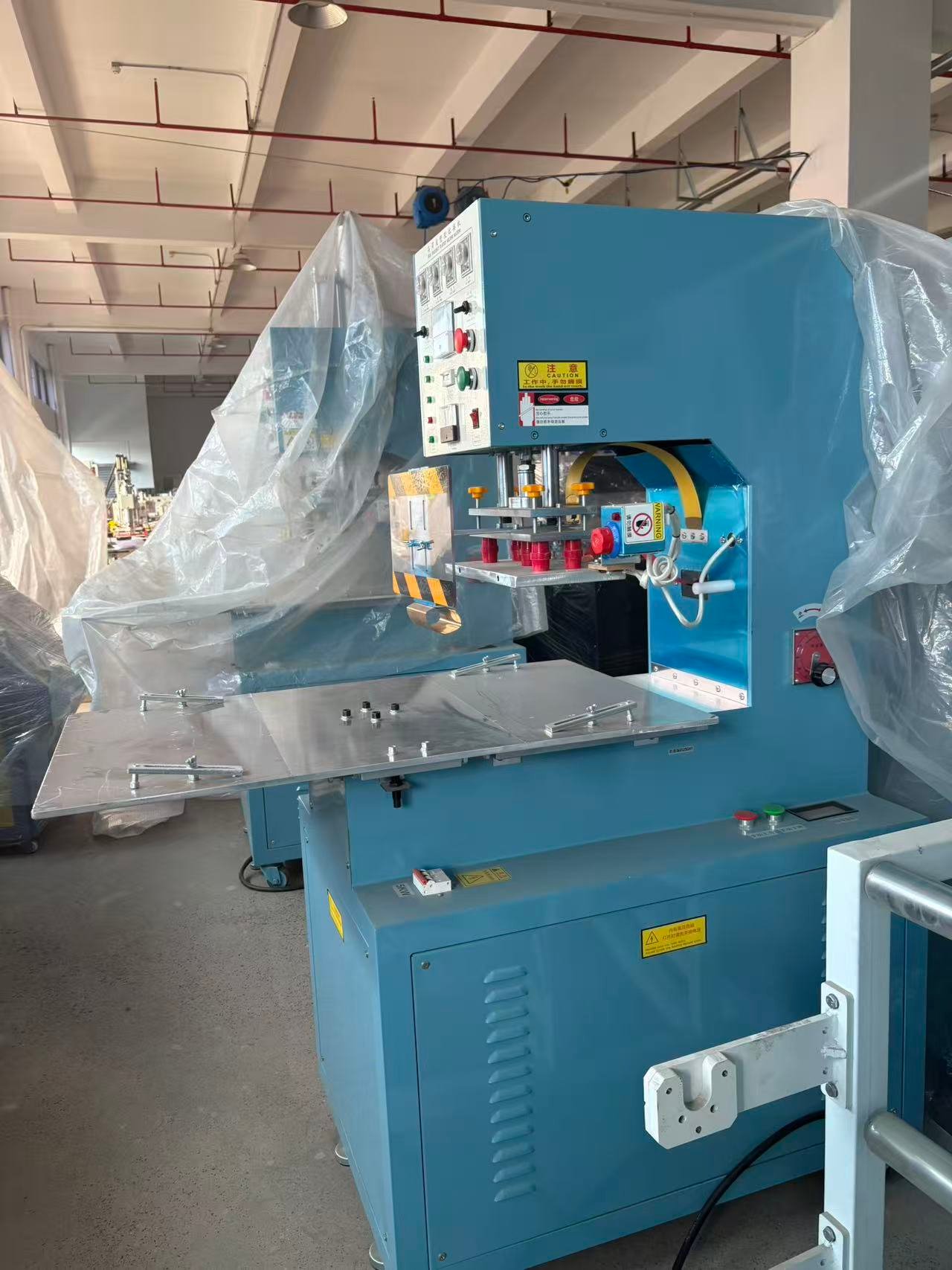
A rotary high frequency welding machine breaks that sequence. It mounts multiple workstations around a circular turntable. The table indexes one position forward at the end of each dwell period. Each station visits the weld position in turn.
While station one welds under the electrode, station two cools in the adjacent position. Station three unloads. Station four loads. All of this happens simultaneously. The generator produces output on every index cycle, not every second or third one.
Why This Matters for Output
On a three-station machine with a four-second weld cycle, the table indexes every four seconds. That is 900 cycles per hour, or roughly 7,200 cycles in an eight-hour shift. A single-station machine running the same product with the same parameters — but with two seconds of loading time between each cycle — produces closer to 2,000 to 3,000 cycles per shift.
The gap widens as station count increases. Published output data for three- to six-station rotary HF welding turntable machines typically ranges from 3,500 to 4,500 cycles per eight-hour shift for compact products like blister packaging and stationery items.
related products
How the Indexing Mechanism Works
The turntable does not rotate freely. A precision indexing unit positions each station under the electrode with accuracy measured in fractions of a millimeter. Consistent die contact depends on this accuracy. Any positional variation across cycles produces inconsistent seam width and variable weld quality.
PLC-Controlled Cycle Sequence
A PLC manages the full cycle sequence: table index, press descent, HF generator activation, weld dwell, cooling dwell, press retraction, and table index again. The operator sets weld time, cooling time, power level, and table speed once. The machine repeats that sequence continuously until the shift ends or the operator stops it.
Adjustable Station Count and Table Speed
Most rotary high frequency welding machine models allow the operator to adjust both table speed and the number of active stations. This flexibility matters when switching between products with different cycle requirements. A thin-film blister product with a two-second weld cycle and half-second cooling time needs fewer stations than a thick PU foam product requiring six seconds of weld and two seconds of cooling.
Adjusting station count without purchasing a new machine is a significant operational advantage. Many manufacturers run two- or three-station configurations on a six-station machine when volume does not justify filling every station.
Rotary vs. Shuttle: The Output Comparison
The shuttle machine is the closest alternative to a rotary high frequency welding machine in terms of output philosophy. Both eliminate idle time by running loading and welding in parallel. But they do it differently — and the difference compounds at scale.
Two Trays vs. Multiple Stations
A shuttle machine has two trays. While one welds, the other loads. The machine cycles between them. This is effective, but the cycle still stops between the loading completion and the weld cycle start whenever the operator is slower than the machine.
A rotary table RF welding machine adds more stations between loading and welding. A four-station machine gives the operator one full index cycle — equal to the weld and cooling time combined — to load and position materials. The operator never races the machine. The machine never waits for the operator.
Cycle Time and Cooling Buffer
Rotary machines also handle long cooling times better than shuttle machines. If a product requires four seconds of weld time and three seconds of cooling, a shuttle machine’s effective output rate is limited by the combined seven-second cycle. A six-station rotary machine using one station for welding, two for cooling, and three for loading/unloading can maintain a higher index rate — effectively decoupling the cooling time constraint from the overall machine output.
Products and Industries That Run Best on Rotary HF Welders
Not every product justifies a rotary machine. The format delivers its greatest value when three conditions exist simultaneously: high volume, consistent product design, and a weld cycle short enough for rapid indexing. When all three align, the automatic rotary HF welder becomes the most cost-efficient option available.
Stationery and Office Products
Ring binders, document pockets, file folders, ID card holders, and pencil cases are the classic rotary machine application. These products run in massive volumes. They use standardized PVC or PETG materials in consistent thicknesses. Their weld areas are compact and their cycle times are short.
High frequency welding stationery production on rotary turntable machines is standard practice in major stationery manufacturing regions. A well-configured rotary machine running binder or pocket production can sustain output rates that no single-station machine approaches regardless of how fast the operator works.
Blister and Clamshell Packaging
PVC and PETG blister packaging for consumer goods — batteries, cosmetics, hardware items, toys, electronics accessories — represents the largest global application category for rotary HF welding turntable machines. The PVC blister turntable welder is specifically designed around the cycle geometry of standard clamshell and card-blister formats.
Three-station machines dominate entry-level blister production. Six-station machines handle the output requirements of high-volume retail packaging lines. Some configurations integrate robotic loading and unloading arms that further reduce labor cost per cycle.
Automotive Interior Components
Automotive applications that involve compact, repeating weld patterns — badge embossing, small trim inserts, fastener housings, decorative labels — suit rotary machine production. The automotive rotary HF machine typically runs at higher power levels (20 kW to 45 kW) with precision indexing to 0.1 mm tolerance, handling materials like PVC-coated fabrics and PU components at sustained rates.
Larger automotive components like door panels and full seat covers are better suited to shuttle machines with large flat work surfaces. But any automotive interior part that can be processed with a compact die and a short cycle time is a candidate for rotary production.
Promotional Items and Branded Merchandise
Key rings, luggage tags, PVC wristbands, promotional patches, and branded packaging all run efficiently on rotary machines. These products often involve multiple weld-and-cut operations on small PVC or TPU workpieces. The rotary format handles the repeatability these products demand at the output rates promotional production schedules require.
Toy and Novelty Packaging
Toy packaging — clamshells, blister cards, and window boxes — frequently uses rotary HF welding. The products run in seasonal high-volume bursts. Rotary machines allow production to scale to those peak demands without holding excess equipment year-round, because the same machine handles multiple product types with die changeovers between runs.
Station Count: How to Choose the Right Configuration
The station count determines how much time the operator has to load each station before it returns to the weld position. Choosing correctly requires knowing your weld and cooling time in advance.
The Basic Calculation
Take your weld time and add your cooling time. That is your total dwell requirement per station. Divide by the number of non-weld stations on the machine — the ones dedicated to cooling, loading, and unloading. The result is how many seconds you have to complete loading at each station before the table indexes that station back to the weld position.
If your dwell requirement is six seconds and you have five non-weld stations, you have roughly one second per station for non-weld operations. That is very fast for a manual loading operation. Add more stations, or reduce dwell time by optimizing weld parameters.
Three Stations
Three-station configurations suit compact products with short weld and cooling cycles — typically two to three seconds total. One station welds, one cools, one loads. Operators must work quickly. This configuration is most effective when products can be loaded in under two seconds per cycle, which is practical for flat blister packaging and simple punched stationery items.
Four to Six Stations
Four to six stations give operators more loading time and allow longer cooling cycles without reducing output rate. This range is the most common in practice. It handles the widest variety of products and gives production managers more flexibility when switching between jobs with different cycle requirements.
Eight Stations
Eight-station machines are used for products with long cooling requirements, multiple weld passes per cycle, or integrated robotic handling that benefits from additional buffer positions between the weld station and the unload position. These are high-capital machines suited to dedicated, high-volume single-product lines.
Key Features to Look For
Every rotary high frequency welding machine on the market uses the same basic turntable concept. What separates well-engineered machines from basic ones comes down to five features.
Precision Index Mechanism
The indexing unit must position each station under the electrode accurately on every cycle. Mechanical wear in a poorly built index drive gradually loosens positioning accuracy. Seam width variation then follows. Look for machines that specify positioning accuracy and use proven index drive designs — gear-driven or servo-driven systems with locking mechanisms that engage at each position.
Arc Suppression Circuit
Continuous operation creates more arc exposure risk than intermittent manual cycling. The HF generator activates hundreds of times per hour. A fast-acting arc suppression circuit cuts power within milliseconds of any arc event. This protects dies on every cycle, not just the ones where an operator happens to notice a problem.
Adjustable Table Speed
Table speed control allows the machine to accommodate different products without mechanical reconfiguration. Stepless speed adjustment is preferable to fixed speed settings. Products with short cycles run the table fast. Products requiring longer loading time run it slower.
PLC with Recipe Storage
Recipe storage is essential for any production environment running more than one product on the same machine. Named parameter sets for each job — power level, weld time, cooling time, table speed — eliminate the need to re-establish settings from scratch after a product changeover.
Compatibility with Robotic Modules
Many rotary HF welding turntable machines accept optional robotic loading and unloading arms. If your production volume justifies it, verify that the machine’s station geometry and PLC interface support robotic integration before purchasing. Adding a robot after the fact on a machine not designed for it is expensive and often impractical.
Power Output and Material Compatibility
Rotary machines for blister packaging and stationery typically operate between 5 kW and 15 kW. This range covers PVC, PETG, APET, EVA, and PU at standard packaging thicknesses.
Machines above 15 kW are used for larger die surfaces, thicker materials, or automotive applications where the weld area per station is significantly larger. Industrial automotive rotary machines run at 20 kW to 45 kW with hydraulic press systems rather than pneumatic ones.
All rotary HF machines handle the same material families as their single-station equivalents: PVC, PU, TPU, PEVA, PET-G, APET, and EVA. Nylon and PET require preheating before the HF cycle and are compatible on machines equipped with heated electrode platens. Non-polar materials such as polyethylene and polypropylene remain incompatible with HF welding regardless of machine format.
When a Rotary Machine Is the Wrong Choice
The rotary format is not the right answer for every situation. Understanding when it does not fit prevents expensive purchasing mistakes.
Frequent Product Changeovers
Rotary machines require a die set for every active station. Switching products means changing dies on multiple stations simultaneously. If your production schedule involves frequent, short runs of many different products, the changeover time and tooling investment erodes the efficiency advantage. A shuttle or push plate machine handles varied product mixes with lower tooling cost and faster setup.
Long Weld Cycles
Products with weld cycles of eight seconds or more require many stations to maintain a reasonable index rate. An eight-second weld cycle on a six-station machine means 450 cycles per hour — better than a push plate machine, but not dramatically better than a shuttle. The rotary advantage compounds at short cycle times. It diminishes at long ones.
Low or Uncertain Volume
A rotary high frequency welding machine costs more than a shuttle or push plate machine at equivalent power ratings. If your volume does not sustain continuous operation for most of each shift, the capital cost per part rises above what simpler formats offer. Verify your production forecast before committing to a rotary configuration.
Frequently Asked Questions
How many parts per shift can a rotary high frequency welding machine produce?
Output depends on station count, weld cycle time, and product type. A three-station machine producing compact blister packs with a three-second total cycle typically produces 3,500 to 4,500 cycles per eight-hour shift. A six-station machine with a faster index rate can reach 6,000 to 8,000 cycles per shift on short-cycle products. Longer weld cycles reduce output proportionally regardless of station count.
What is the minimum station count for a rotary HF welding turntable machine?
Two stations is the minimum — equivalent to a shuttle machine in principle, but with continuous rotary motion rather than linear reciprocation. Three stations is the practical minimum for most production applications. Four stations or more is recommended for products with cooling times longer than the weld time, or for operators who need more loading time per cycle.
Can one rotary machine run multiple product types?
Yes, with die changeovers between runs. Most rotary HF welding machines accept quick-change die holders that reduce changeover time. Some configurations allow different dies in different stations simultaneously, enabling multi-step welding sequences on a single product rather than multi-product simultaneous production.
What materials can an automatic rotary HF welder process?
All standard HF-compatible thermoplastics: PVC, PU, TPU, PEVA, PET-G, APET, GAG, and EVA. Nylon and PET require preheating. Non-polar materials including polyethylene and polypropylene are not HF-weldable on any machine format.
Is a rotary machine always better than a shuttle for high-volume production?
For products with short, consistent cycles and sustained high volume, yes. For products with long cycles, frequent changeovers, or variable run lengths, a shuttle machine often delivers better overall efficiency at lower cost. The right choice depends on your actual production profile — not just your peak output target.