 TEL +86-13923172919
High Frequency Welding Machine for Tarpaulin, Tents, and Industrial Covers: What Wattage Do You Actually Need?
Tarpaulin production has one requirement that separates it from almost every other HF welding application: the seams are long. A truck cover may need 30 meters of continuous welding. A marquee tent can require hundreds of meters across all its panels. A high frequency welding machine for tarpaulin must produce those long, straight, strong seams consistently — and the generator must have enough power to do it without slowing down or overheating.
Getting the wattage wrong in this application is expensive. Too little power means slow cycle times, incomplete fusion, and weak seams. Too much power adds cost without adding performance. This guide helps you calculate what you actually need.
Why Tarpaulin and Tent Production Demands More Power
Standard HF welding applications — blister packaging, stationery, medical bags — involve small die areas and short seams. A 5 kW or 8 kW machine handles most of them comfortably.
The Area Problem
PVC tarpaulin welding works differently. The seam bar runs the full width of the overlap in a single press cycle. A standard seam on a truck tarp uses an overlap of 38 mm to 50 mm — roughly 1.5 to 2 inches wide. Multiply that width by the bar length — which can be 500 mm to 1,200 mm on a fixed-station machine — and the total electrode surface area in contact with the material is ten to thirty times larger than a typical blister packaging die.
Power requirements scale with weld area. The same fundamental relationship applies: more surface area requires more generator output to achieve fusion in an acceptable cycle time. A thin PVC film blister seal uses around 40 square centimetres per kilowatt as a rough planning guide. Heavy tarpaulin at 500 g/m² to 900 g/m² needs proportionally more power per unit area, and the total area per cycle is much larger to begin with.
Material Thickness and Weight
Tarpaulin fabrics carry a PVC coating over a base scrim. The total combined thickness is typically 0.5 mm to 1.5 mm, depending on product weight. Heavier industrial covers — truck side curtains, geomembrane liners, military-grade shelter panels — run at 1.0 mm to 2.0 mm combined thickness. Thicker material requires more energy to heat to fusion temperature within a useful cycle time.
A 15 kW generator handles standard PVC tarpaulin welding for tents and truck covers in the typical commercial weight range. A 20 kW to 25 kW generator covers heavier industrial membrane applications and wider seam bars. Machines at 30 kW to 45 kW are reserved for the heaviest structural membrane work — aircraft hangars, large-span tensile structures, and reinforced geomembranes.
The Two Machine Types for Tarpaulin HF Welding
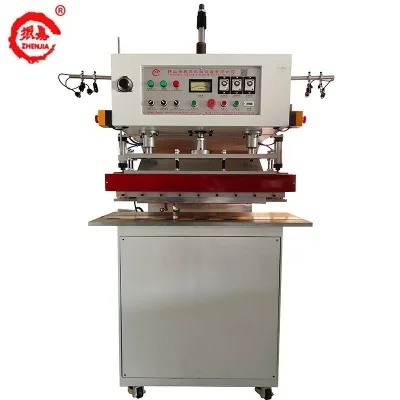
Two fundamentally different machine configurations serve tarpaulin, tent, and industrial cover production. Each handles a different production scenario.
Fixed-Station Bar Welder
A fixed-station canvas welding machine uses a stationary press with a long bar electrode — typically 500 mm to 1,200 mm. The material moves under the bar manually for each press cycle. The operator aligns the overlap, activates the press, waits for the weld and cooling cycle, then advances the material and repeats.
Fixed-station bar welders suit short seams, shaped welds, and products that require multiple electrode changes per job. Welding tent panels with curved peak seams, angled corner reinforcements, or custom pocket configurations requires precise manual positioning that the fixed-station format handles well.
The workspace depth — the clearance behind the electrode that allows large material panels to be fed through — is a critical specification on these machines. Machines designed specifically for tarpaulin work typically offer 800 mm to 1,200 mm of throat depth behind the weld bar. This allows large panel sections to be handled without bunching or misalignment.
Travelling Head HF Welder
The travelling head HF welder moves the welding head along a track while the material stays flat on the table. The operator lays the tarp panels on the table, aligns the overlap using laser guide lines, and activates the machine. The welding head travels the full seam length automatically at a controlled speed, welding continuously from one end to the other.
The travelling head format is the standard choice for any product with long, straight seams. Truck covers, pool liners, billboard canvases, high-speed door panels, and large tent sections all run faster and more consistently on a travelling head machine than on a fixed-station bar welder. Travel lengths range from 3 meters on compact machines to over 100 meters on large-format industrial welders.
Some travelling head HF welders use a vacuum work table — the table surface uses suction to hold the material flat during welding. This prevents material shifting, eliminates the need for clamps, and ensures consistent seam width along the full travel length. For large-format materials that are heavy enough to self-weight on the table, vacuum suction is less critical but still improves alignment accuracy.
How to Calculate the Wattage You Need
The following approach gives a working estimate for power selection before you contact a machine supplier for a final specification.
Step 1 — Determine Your Seam Width
Standard seam widths for tarpaulin and tent production range from 20 mm to 70 mm. A 40 mm overlap on standard commercial PVC tarpaulin is a common starting point. Wider seams are used for structural membranes and products that carry high tensile loads. The seam width directly determines the electrode contact area for each cycle.
Step 2 — Determine Your Bar Length or Travel Segment Length
On a fixed-station machine, the bar length is the electrode length — typically 500 mm to 1,000 mm. Each press cycle welds that full length. On a travelling head machine, weld area is calculated differently: the travelling head presses and welds a length determined by its own electrode length — usually 100 mm to 200 mm — as it travels continuously along the seam. The generator must sustain continuous output for the full travel duration.
Step 3 — Estimate Required Power
A widely used planning figure for standard flexible PVC tarpaulin material is approximately 40 cm² of weld area per kilowatt of generator output for a three-second cycle at ambient electrode temperature. This figure is conservative for lighter materials and increases for heavier PVC laminates.
Example: a fixed bar 800 mm long with a 40 mm seam width gives 320 cm² of contact area. At 40 cm² per kW, that requires 8 kW as a minimum. For heavy-weight tarpaulin at 700 g/m² or above, multiply by a factor of 1.5 to 2 to account for the additional energy needed per unit area — putting the requirement at 12 kW to 16 kW for the same geometry.
Always add a 20 to 30 percent headroom margin to any calculated figure. Running a generator at maximum rated output continuously degrades components faster and reduces the available safety margin for material variation between rolls. A 15 kW machine specified for a 12 kW calculated requirement will run cooler, last longer, and handle occasional heavier material without parameter adjustment.
Step 4 — Account for Continuous Duty
Fixed-station machines operate in short press cycles with pauses between each cycle while the operator advances the material. This intermittent duty profile gives the generator time to cool between cycles.
Travelling head machines can run continuously for 30 seconds to several minutes on a single pass, depending on seam length. Continuous duty is harder on generators than intermittent cycling. When specifying a travelling head HF welder for long seams, ensure the machine is rated for continuous output — not just peak output. Many solid-state generator designs handle continuous duty significantly better than vacuum tube equivalents because they generate less internal heat at equivalent output levels.
Wattage Guide by Product Type
The following ranges represent common production configurations. They are starting points for discussion with your machine supplier, not final specifications.
Light Tent Fabric (under 400 g/m²)
Lightweight event tents, promotional canopies, and thin banner fabric. Seam width typically 20 mm to 35 mm. A 10 kW to 15 kW machine handles most applications in this category on both fixed-station and compact travelling head configurations.
Standard Commercial Tarpaulin (400–700 g/m²)
Truck covers, standard event tent panels, agricultural covers. Seam width typically 35 mm to 50 mm. This is the largest single application category for the high frequency welding machine for tarpaulin. A 15 kW to 20 kW machine suits most production runs. Fixed-station machines or travelling head models with up to 12 meters of table length are common in this segment.
Heavy Industrial Tarpaulin (700–900 g/m²)
Industrial truck curtain sides, reinforced shelter panels, heavy storage covers. Seam width typically 40 mm to 60 mm. A 20 kW to 25 kW machine is the standard recommendation. Heated electrode platens improve seam consistency on materials in this weight range by pre-warming the PVC surface before each cycle begins.
Structural Membrane (over 900 g/m²)
Tensile architecture, aircraft hangars, large-span permanent shelters, containment booms, geomembrane liners. Seam widths of 50 mm to 70 mm are common. Generator output of 25 kW to 45 kW is required. These machines are large-format industrial installations — long table systems, precision linear motion systems, and integrated vacuum suction tables are standard at this level.
Pool Liners and Fluid Containment
Swimming pool liners, water cisterns, oil containment barriers, biogas digesters. These products require long, straight seams with absolute waterproof integrity. Seam quality and consistency are more critical than production speed. Travelling head machines in the 15 kW to 25 kW range are the standard choice. The travelling head format ensures seam straightness over long lengths that a fixed-station machine cannot guarantee through manual material advancement.
Why HF Welding Outperforms Hot Air for Tarpaulin Production
Hot air welding is the main alternative to HF for PVC tarpaulin seam welding. Both methods work. But they produce different results, and understanding the difference matters when choosing equipment for structural or heavy-duty applications.
Seam Strength
HF welding fuses material from the inside out. The seam forms at the molecular level throughout the full thickness of the overlap. Hot air applies heat to the surface of the material from outside. The outer surfaces heat first, and inner fusion depends on heat conduction through the coating. For thick PVC laminates, achieving complete through-thickness fusion with hot air requires careful temperature control. Under-fusion produces a seam that peels under load even though its surface appearance is acceptable.
Published testing consistently shows HF-welded PVC tarpaulin seams achieving strengths at or above the base material tensile strength. Hot air seams can match this performance when parameters are precisely controlled, but their process window is narrower and more sensitive to ambient temperature and material variation.
Seam Appearance and Consistency
HF-welded seams have a clean, defined edge and a consistent seam width. The die geometry controls the seam profile precisely. Hot air seams depend on roller pressure, travel speed, and air temperature — three variables that interact with each other and with ambient conditions. Maintaining consistent appearance over long seam runs on hot days or in cold workshops requires constant operator attention.
Process Speed
HF welding is generally faster per linear meter on PVC tarpaulin than hot air welding because the internal heating mechanism reaches fusion temperature faster than surface-applied heat can conduct through the material. Travelling head HF welders produce straight seams of 5 meters to 15 meters in 30 seconds to 90 seconds depending on seam width and material weight. Comparable hot air production times are longer for equivalent material.
Key Features to Look For in a Tarpaulin HF Welder
Table Depth and Material Handling
The throat depth — clearance behind the electrode — determines how large a panel section you can feed through the machine. For tarpaulin production, minimum useful throat depth is 800 mm. Machines with 1,000 mm to 1,200 mm or more are preferable for large truck cover and tent panel work. Tables with extending side sections allow even larger panel areas to rest flat during welding.
Laser Guide Lines
Laser guide lines projected onto the work table surface allow the operator to align the material overlap precisely and consistently. This is a standard feature on purpose-built travelling head HF welders and high-quality fixed-station tarpaulin machines. Without laser guides, seam placement accuracy depends entirely on operator skill and marking.
Vacuum Table Option
A negative-pressure table surface holds material flat without clamps, preventing slip during welding. This is especially useful for large lightweight panels that the operator cannot fully tension by hand. Vacuum tables are more common on travelling head machines where the welding head moves away from the operator’s position.
Interchangeable Electrode Bars
Different seam widths and profiles require different electrode bars. A machine designed for tarpaulin and tent work should accept quick-change bars of different widths — typically 20 mm, 40 mm, and 60 mm widths as a minimum range. Some machines also accept curved electrode bars for welding round window profiles in tent panels and circular inflatable products.
Solid-State Generator
Solid-state generators handle continuous-duty operation better than vacuum tube equivalents. For travelling head applications with long seam runs, solid-state designs maintain more stable output over extended cycles and require less maintenance. The arc protection circuits in solid-state machines also respond faster, which is important when welding on long seams where a brief arc event would damage a large section of electrode before a slower tube-type protection circuit could respond.
Frequently Asked Questions
What is the minimum wattage for welding standard PVC truck tarpaulin?
For standard truck tarpaulin in the 500 g/m² to 700 g/m² range with a seam width of 40 mm to 50 mm, a 15 kW machine is the recommended starting point. A 12 kW machine can handle lighter material at the low end of that weight range, but 15 kW gives adequate headroom for material variation and prevents the generator from running at maximum output continuously during long seam runs.
Can the same machine weld both tent fabric and heavy industrial tarpaulin?
Yes, if the machine’s power output covers the heavier material requirement. A 20 kW machine handles both light tent fabric and heavy industrial tarpaulin by adjusting power output, weld time, and seam width settings. Running light tent fabric on a 20 kW machine simply means using a lower power setting. The reverse — running heavy industrial membrane on an undersized machine — requires longer weld times that reduce production speed and increase die temperature buildup.
Why do some tarpaulin welders use two bars?
Some machines use dual electrode bars — two parallel bars that contact the material simultaneously in the same press cycle. One bar seals the inner seam line; the other seals the outer seam line. This eliminates a second production pass for double-seam applications and ensures exact, consistent spacing between the two seam lines. Dual-bar configurations are common in truck side curtain production where double seams are specified for structural reasons.
What is the travel speed of a travelling head HF welder on standard PVC tarpaulin?
Travel speed depends on generator power, seam width, and material weight. On standard commercial PVC tarpaulin with a 40 mm seam width and a 15 kW generator, typical travel speeds range from 1 to 3 meters per minute. Higher power allows faster travel at equivalent weld quality. Most travelling head machines have adjustable speed control — matching speed to material is part of the initial setup process rather than a fixed specification.
Can an HF welding machine weld PE or PP tarpaulin?
Standard polyethylene (PE) and polypropylene (PP) are non-polar materials and do not respond to the electromagnetic field in a standard HF welding process. However, some specialized machines and electrode configurations use pulse heating techniques that apply heat through a PTFE-coated bar to a heat-activatable adhesive tape laminated to the PE surface — effectively welding through an intermediary rather than the base material directly. This is not true HF welding but is used on machines that can switch between HF and impulse heating modes for customers who weld both PVC and PE products on the same equipment.