 TEL +86-13923172919
What Is Buffer Material in HF Welding and When Do You Actually Need It?
Buffer material is the unglamorous workhorse of high frequency welding. It is not metal., not shape the weld. And it sits quietly between the die and the press platen, or between the material and the lower bed, and does the jobs that metal cannot do. Many operators ignore it until something goes wrong. Then it becomes the most important component in the machine.
A buffer material RF welding layer is a sheet of electrically insulating, thermally resistant, and mechanically resilient material. It performs four essential functions in every HF welding cycle: electrical insulation to prevent arcing, thermal insulation to manage heat flow, pressure equalization to compensate for minor misalignments, and thickness compensation to fill gaps in multi-layer assemblies.
Skip the buffer material and you invite arcing, scorching, weak welds, and damaged dies. Use the right buffer and your process runs cooler, safer, and more consistently. This guide explains what a HF welding buffer layer actually does, which materials work best, and when you absolutely must use one.

The Four Jobs a Buffer Material Performs in Every Weld Cycle
A buffer layer is not a single-purpose accessory. It is a multifunctional component that actively manages electrical, thermal, and mechanical conditions at the weld interface.
Job One: Electrical Insulation and Arc Prevention
The buffer material sits directly between the live RF electrode and the grounded press platen. It forms a dielectric barrier that prevents current from finding a direct path to ground through the machine frame. Without this barrier, any breakdown in the primary machine insulation results in a dangerous short circuit.
The buffer also suppresses the electric field concentration at sharp die edges. Electric field lines bunch up at corners and edges. This concentration can ionize the surrounding air and initiate an arc. A properly fitted buffer that extends slightly beyond the die edges smooths the field gradient. It reduces the field intensity at the die perimeter and makes arcing far less likely to occur.
This is why a prevent arcing RF welding strategy always includes a buffer layer as part of the fundamental setup. The buffer does not just protect against arcs that have already started. It prevents them from starting in the first place by managing the electric field geometry.
Job Two: Thermal Insulation and Heat Management
HF welding generates intense heat at the material interface. Some of that heat conducts upward into the die and downward into the lower platen. A buffer material acts as a thermal barrier. It slows this heat flow and keeps the press structure cooler.
This thermal management serves multiple purposes. It reduces thermal expansion in the press platens, which helps maintain die alignment during long production runs. It protects the press hydraulic or pneumatic seals from heat degradation. And It also retains more heat in the weld zone itself, which can improve process efficiency on materials that benefit from a slightly hotter die surface.
The RF welding dielectric buffer must balance thermal resistance with thermal stability. The material must withstand repeated exposure to welding temperatures without degrading, melting, or losing its mechanical properties.
Job Three: Pressure Equalization Across the Die Face
No press platen is perfectly flat at the micron level. No fabricated die maintains perfect parallelism across its entire length and width. These small dimensional variations create pressure concentrations at the high points. The low points receive insufficient pressure and produce weak or incomplete welds.
A resilient buffer material compresses slightly under load. This compression absorbs the dimensional variations. The applied tonnage distributes evenly across the entire sealing face. Every point along the seal receives the same pressure, which means every point receives the same weld quality.
Silicone rubber sheets from 0.5mm to 3mm thickness are the most common pressure-equalizing buffers. Thicker sheets accommodate larger misalignments. Thinner sheets provide more precise pressure transmission for applications requiring tight dimensional control.
Job Four: Thickness Compensation in Multi-Layer Assemblies
Many HF-welded products involve multiple material layers that do not have uniform thickness across the weld area. A medical fluid bag may have a port bonded into the perimeter seal. The port area is thicker than the surrounding film layers. Without compensation, the thin areas receive no pressure while the thick port area bears the entire press load.
A buffer material conforms around thickness variations. It fills the gaps and transmits pressure to both thick and thin sections simultaneously. This compensation ability is critical for products that include inserted components, reinforcement patches, or transitions between different material gauges.
相关产品
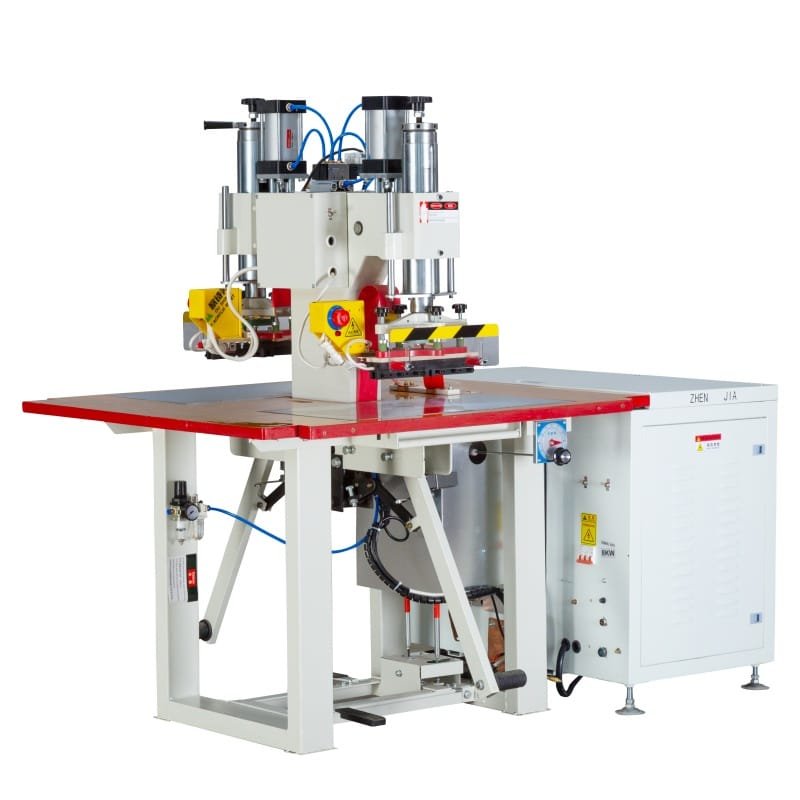
Common Buffer Materials: Teflon, Silicone, and Fabric
Several materials serve as effective buffer material RF welding layers. Each offers a different balance of electrical, thermal, and mechanical properties. The right choice depends on your application temperature, pressure requirements, and cycle rate.
Teflon (PTFE) Buffer: High Temperature and Non-Stick Performance
A Teflon buffer HF welder layer is the premium choice for demanding applications. PTFE withstands continuous operating temperatures up to 260°C, far above the peak temperatures reached in HF welding. It is chemically inert and does not react with plasticizers, adhesives, or material coatings.
Teflon has an extremely low coefficient of friction. Melted material does not stick to it. This non-stick property is invaluable when welding materials that tend to extrude flash or when welding PVC compounds with high plasticizer content that can migrate and foul other buffer surfaces.
Teflon also offers excellent dielectric strength. It insulates effectively even in very thin sheets, making it ideal for applications where buffer thickness must be minimized to maintain precise die positioning.
The main drawback of Teflon is cost. It is significantly more expensive than silicone or fabric buffers. It is also less compressible, which limits its pressure-equalizing performance on presses with significant platen misalignment. Teflon is best used as a thin top sheet over a more compressible silicone underlayer, combining the non-stick and thermal benefits of PTFE with the pressure-equalizing ability of silicone.
Silicone Rubber Buffer: The All-Round Workhorse
Silicone rubber is the most widely used HF welding buffer layer material. It offers an excellent combination of properties at a moderate cost. Silicone handles continuous temperatures up to 230°C, adequate for all common HF welding applications. It compresses and rebounds reliably over millions of cycles without taking a permanent set.
Silicone buffers come in a wide range of thicknesses and hardness ratings. Soft silicone sheets in the Shore A 30 to 50 range provide maximum conformability for pressure equalization and thickness compensation. Harder sheets in the Shore A 60 to 80 range provide more precise pressure transmission for applications requiring tight dimensional control.
Silicone also provides excellent dielectric insulation. Its high dielectric strength makes it effective at suppressing arcing even in relatively thin sheets. Standard silicone buffers last for tens of thousands of cycles before requiring replacement. Premium silicone compounds with enhanced tear resistance extend that life further.
The limitation of silicone is its vulnerability to certain plasticizers and solvents. Some PVC formulations contain plasticizers that can migrate into the silicone and cause it to swell and soften over time. If you notice your silicone buffer becoming sticky or losing its shape, switch to a plasticizer-resistant grade or consider adding a thin Teflon separator sheet.
Fabric-Reinforced Buffer: Durability for Heavy-Duty Applications
Fabric-reinforced buffers embed a woven fiberglass or polyester fabric inside a silicone or rubber matrix. The fabric provides tensile strength and dimensional stability. It prevents the buffer from stretching, tearing, or extruding under high pressure.
These reinforced buffers suit heavy-duty applications with high clamping forces. Large-format dies, multi-cavity tooling, and presses with high tonnage ratings all benefit from the added mechanical strength of a fabric-reinforced buffer. The fabric layer also helps the buffer maintain its shape over extended use, reducing the frequency of replacement.
Fabric-reinforced buffers are thicker than plain silicone sheets. They typically start at 1.5mm and range up to 5mm or more. This thickness provides excellent pressure equalization but may be too thick for applications where precise die positioning is critical.
Phenolic Laminate Buffer: Rigid Insulation for Special Cases
Phenolic laminate, a hard, rigid material made from paper or fabric impregnated with phenolic resin, serves as a buffer in specific high-temperature or high-voltage applications. It does not compress significantly. It insulates electrically and thermally while maintaining precise dimensional stability.
Phenolic buffers are used where a soft, compressible buffer would cause unacceptable variation in weld dimensions. They suit applications like precision electronic component encapsulation and certain medical device assemblies where the seal geometry must be held to tight tolerances.
The trade-off is that phenolic provides no pressure equalization. The die and platen must be perfectly parallel, because the buffer will not compensate for any misalignment. Phenolic buffers are also brittle and can crack if overloaded or if the die has sharp edges that concentrate stress.
What Happens When You Skip the Buffer Material
Operating an HF welding machine without a proper RF welding dielectric buffer produces predictable failures. Each failure mode traces back to one of the four jobs the buffer normally performs.
Arcing and Die Damage
Without the insulating buffer, the electric field at the die edges concentrates fully. Arcing initiates at sharp corners and edges. Each arc etches a pit into the die surface and burns the product. Over time, the die edge erodes, requiring more frequent re-grinding or early replacement.
Scorched Product and Overheating
Without the thermal barrier, heat conducts rapidly from the die into the press platen. The die surface runs cooler than intended. Operators compensate by increasing power or time, which pushes the process closer to the material’s degradation limit. The lack of thermal buffering also means the die temperature fluctuates more with ambient conditions, making the process harder to control.
Inconsistent Weld Strength
Without pressure equalization, the high spots on the die receive full clamping force while the low spots receive almost none. The weld varies from strong and over-welded in some areas to weak and under-welded in others. A product that passes a peel test on one section may fail on another section produced in the same cycle.
Incomplete Seals on Multi-Thickness Assemblies
Without thickness compensation, the press clamps on the thickest section and leaves the thinner sections with a gap. The thin sections receive no pressure and no effective welding. Products with inserted ports, reinforcement patches, or varying layer counts develop leaks at the thin sections that never fully sealed.
When You Absolutely Need a Buffer Material
Not every HF welding setup requires a separate buffer sheet. Some machines integrate the buffer function into the lower platen covering or into the die mounting system. However, you must have a functional equivalent of the buffer in place whenever any of the following conditions apply.
You need a buffer when your die has sharp edges or corners that concentrate the electric field. You need a buffer when your press platens show any measurable deviation from perfect parallelism, which is virtually all presses after their first year of operation. Probably You need a buffer when welding heat-sensitive materials where temperature control is critical to avoiding scorching. And You need a buffer when your product assembly includes layers of different thicknesses that must all seal simultaneously.
You can probably operate without a separate buffer only if your machine has an integrated buffer surface in good condition, your dies have generously radiused edges, your platens are verified parallel to within 0.02mm, and your products have uniform thickness across the entire seal area. Few production environments meet all of these conditions simultaneously.
Quick Reference for Buffer Material Selection
| Application | Recommended Buffer | Typical Thickness | Replacement Cycle |
|---|---|---|---|
| Standard PVC welding | Silicone, Shore A 50 | 1.0–2.0mm | 20,000–50,000 cycles |
| High-temperature PU/TPU | Teflon over Silicone | 0.5mm PTFE + 1.5mm Silicone | 30,000 cycles |
| Heavy-duty large format | Fabric-reinforced Silicone | 2.0–3.0mm | 15,000–25,000 cycles |
| Precision thin-film | Teflon only | 0.3–0.5mm | 10,000–20,000 cycles |
| High-voltage generator | Phenolic laminate | 2.0–5.0mm | Inspect monthly |
| Multi-thickness assemblies | Soft Silicone, Shore A 30 | 2.0–3.0mm | Replace when compression set visible |
Buffer Material Maintenance and Replacement
A buffer material wears out. Silicone loses its resilience after repeated compression cycles. Teflon thins and develops pinholes. Fabric layers delaminate. A worn buffer gradually stops doing its four jobs, and weld quality degrades in ways that are difficult to diagnose until the problem becomes severe.
Inspect your buffer material at every die change. Look for surface cuts, tears, or embedded debris. Feel for hard spots that indicate localized compression set. Check thickness with a micrometer at several points. Replace the buffer when the thickness varies by more than 20% from its original value or when any cut or tear reaches the die footprint area.
Keep spare buffer material cut to size for every machine. The cost of a buffer sheet is trivial compared to the cost of the scrap, die damage, and downtime that a failed buffer causes. Change the buffer before it forces you to. Your HF welding buffer layer is the cheapest insurance policy on your production floor.