 TEL +86-13923172919
High Frequency Welding vs. Heat Sealing: Are They the Same Thing? Key Differences Explained
A persistent confusion runs through the plastic joining industry. Many engineers, buyers, and even seasoned operators use the terms “high frequency welding” and “heat sealing” interchangeably. They treat them as synonyms for the same basic operation: applying heat and pressure to join two plastic layers. This assumption is not merely imprecise. It leads to selecting the wrong equipment, the wrong materials, and the wrong process parameters for the job.
The truth behind high frequency welding vs heat sealing reveals two fundamentally different physical mechanisms. One generates heat inside the material through molecular excitation. The other conducts heat into the material from an external source. The distinction matters because it determines which plastics you can join, how thick a stack you can weld, and how strong the resulting seam will be.
This guide clarifies the RF welding vs heat sealing difference once and for all. It explains why dielectric welding vs heat sealing is not a debate between competing technologies but a choice between processes that operate on entirely different principles.
Why the Confusion Exists in the First Place
Heat sealing and HF welding look similar from a distance. Both use a press. And Both apply pressure. Both produce a warm, fused joint. An operator watching either machine from across the room sees a platen close, a brief cycle, and a finished part emerge. The superficial resemblance hides a deep technical divide.
The terminology also blurs the line. Heat sealing is a broad, generic term that covers any method using thermal energy to bond materials. High frequency welding is one specific way to generate that heat, but its mechanism is so different from conduction or radiation that grouping it under “heat sealing” misrepresents what actually happens. Calling HF welding a type of heat sealing is like calling a microwave oven a type of stove. Both cook food, but nobody confuses the two in practice.
This conflation matters because answering is HF welding the same as heat sealing incorrectly leads to expensive mistakes. A buyer who thinks a cheap hot-bar sealer will replace an HF welder discovers the hard way that PVC sheet thicker than half a millimeter refuses to bond. A manufacturer who orders an HF machine expecting it to seal polyethylene film gets a cold, unwelded stack of plastic. The two processes serve different materials and different product requirements.
The Heating Mechanism: Internal Molecular Friction vs. External Conduction
The fundamental high frequency welding vs heat sealing difference lives in how heat reaches the joint interface. One path goes from the inside out. The other goes from the outside in.
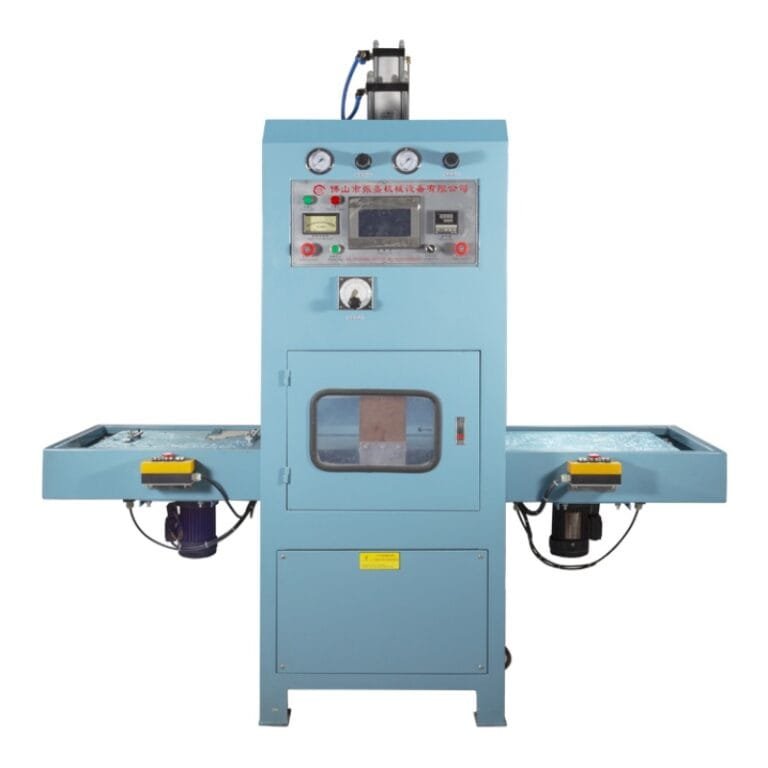
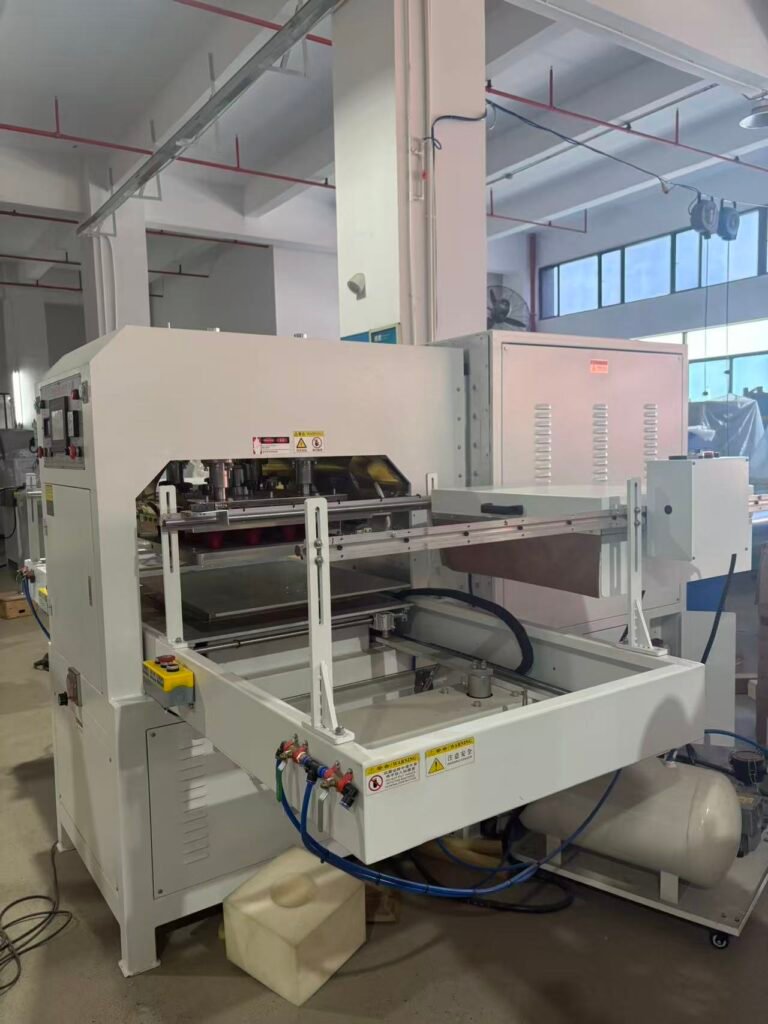
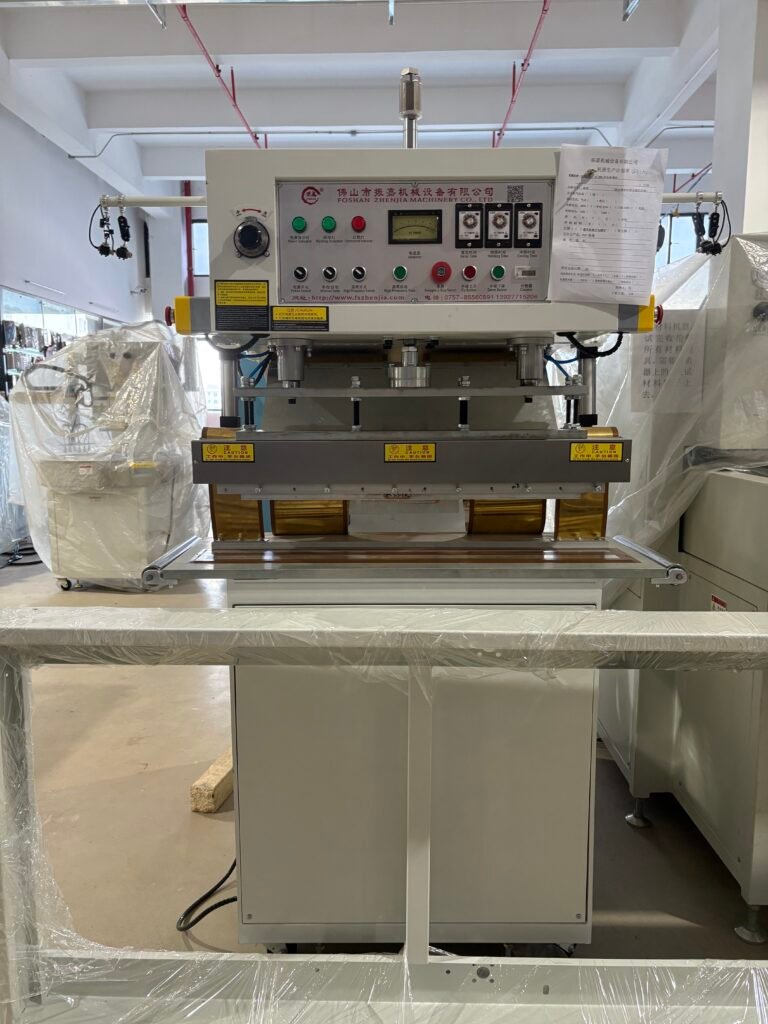
High frequency welding, also called RF or dielectric welding, applies an alternating electromagnetic field at 27.12 MHz across the material stack. Polar molecules within the plastic attempt to align with the rapidly reversing field. Their collective vibration creates friction at the molecular level. Heat generates simultaneously through the entire material thickness, with peak intensity at the center where the two layers meet. The material itself becomes the heat source.
Heat sealing relies on conduction or radiation from an external heating element. A hot bar, a heated roller, an infrared lamp, or a stream of hot gas raises the surface temperature of the plastic. That heat then travels inward through the material by conduction. The surface gets hot first. The interior follows later, assuming the process runs long enough. The heating element is the heat source. The material is merely the recipient.
This internal-vs-external distinction drives every performance difference between the two processes. Dielectric welding vs heat sealing is not a comparison of two heating methods. It is a comparison of two entirely different physical phenomena applied to plastic joining.
Material Compatibility: Polar vs. Non-Polar Plastics
Walk down the material aisle and the RF welding vs heat sealing difference becomes immediately practical. Each process works on a distinct set of thermoplastics.
High frequency welding demands polar materials. The molecules must have an uneven charge distribution to respond to the electric field. Flexible PVC, with its strongly polar chlorine atoms, welds beautifully. Polyurethane and TPU follow closely. EVA, with its polar acetate groups, responds well. PETG contains polar ester linkages and welds with proper parameter control. These materials define the HF welding application space.
Heat sealing, by contrast, does not care about molecular polarity at all. The external heater will warm up anything placed against it. Polyethylene and polypropylene, the non-polar materials that HF cannot touch, seal readily with a hot bar or hot air. The same applies to polystyrene, nylon, and most other thermoplastics. Heat sealing’s material range is broader and more forgiving simply because external heat makes no electrical demands on the material.
The trade-off runs both ways. HF welding achieves fusion at the molecular level with the most responsive materials. Heat sealing achieves surface adhesion across a wider material spectrum. A manufacturer running PVC medical bags gains everything from HF. One running polyethylene packaging film gains everything from heat sealing. Selecting correctly starts with knowing which camp your material falls into.
Material Thickness: The Conductivity Barrier
Thick materials expose the thermal limitation of heat sealing in a way that thin films never do. Plastic is a thermal insulator. Heat applied to the surface conducts slowly toward the center. The thicker the stack, the longer the conduction path and the greater the temperature difference between the outer skin and the inner bond line.
Consider a 2-millimeter PVC assembly. Heat sealing must raise the surface to a temperature significantly above the melting point to drive enough heat inward. The surface risks scorching, discoloring, or degrading before the interface ever softens. Cycle times stretch. Quality becomes inconsistent.
High frequency welding bypasses this entire problem. The electric field penetrates the full thickness instantly. Molecular vibration starts everywhere at once. The center of the stack reaches welding temperature simultaneously with the outer layers. There is no thermal gradient to fight. Thick assemblies up to several millimeters weld through completely without surface damage. This is why inflatable boat fabric, heavy tarpaulins, and multi-layer medical bags all depend on HF technology. Heat sealing simply cannot deliver reliable through-heating on stacks beyond about 0.5 millimeters of PVC.
Weld Strength: Through-Fusion vs. Surface Bond
Peel apart a joint from each process and the strength difference tells its own story.
An HF-welded seam tears through the parent material. The two layers have fused into one continuous cross-section. Polymer chains crossed the original boundary and entangled during the molten phase. The joint strength approaches the tensile strength of the material itself. Peel tests on properly welded PVC regularly exceed 30 Newtons per centimeter. Leak tests on medical bags hold until the film bursts, not until the seal separates.
A heat-sealed joint peels apart along the bond line. The two layers adhered to each other rather than fused into one. Surface contact and a thin melt layer provide the bond. The strength depends on the quality of that surface contact, the temperature uniformity of the hot bar, and the pressure applied during cooling. Properly executed heat seals perform reliably on thin films for packaging applications. They cannot, however, match the cohesive strength of an HF fusion bond.
The distinction between adhesion and fusion is the most important high frequency welding vs heat sealing takeaway for anyone designing a product that must hold pressure, survive sterilization, or resist peel forces in service.
Production Speed and Tooling Geometry
Speed comparisons depend heavily on the part design and the production volume.
HF welding completes the entire seal perimeter in a single 2- to 10-second cycle. The die welds and often trims the part simultaneously. Multi-cavity tooling produces several finished parts per cycle. High-volume production of medical pouches, inflatable products, and stationery items achieves throughput rates that no sequential heat sealing operation can match.
Heat sealing with a hot bar or impulse sealer seals one straight line segment at a time. A rectangular pouch requires four separate sealing operations plus trimming. Rotary heat sealers run continuous film at high speed but are limited to simple seam patterns. Complex perimeters with internal seals demand sequential operations or specialized tooling.
The throughput advantage tips toward HF when parts have complex seal geometries and medium to high production volumes. Heat sealing shines on simple linear seals at very high film speeds, especially for thin single-layer films in the packaging industry.
The Application Divide
Markets have already sorted themselves between these two technologies based on the physics described above.
HF welding dominates medical flexible packaging. Blood bags, IV bags, drainage pouches, and sterile barrier systems require the through-fusion, leak-proof seams that only dielectric heating can provide. Inflatable products—boats, air mattresses, life jackets—rely on HF for the same reasons plus the ability to weld thick reinforced fabrics. Stationery products with transparent PVC and long perimeter seals belong firmly in HF territory.
Heat sealing dominates consumer packaged goods. Snack food bags, pharmaceutical blister lidding, medical device pouches made from polyolefin films, and countless other thin-film packaging applications run on heat sealers worldwide. The equipment costs less, the materials are often polyethylene or polypropylene, and the seal requirements are satisfied by a properly executed surface bond.
The two technologies rarely compete for the same application. Material choice and product requirements push the decision decisively toward one or the other long before cost enters the calculation.
Making the Right Choice for Your Product
Ask three questions when deciding between high frequency welding vs heat sealing for a new product or a process upgrade.
Question one: what is the primary material? PVC, PU, TPU, or EVA points directly to HF welding. Polyethylene, polypropylene, or other non-polar thermoplastics point to heat sealing.
Question two: how thick is the material stack at the seal area? Stacks under 0.5 millimeters with simple seals can go either way depending on material. Stacks over 0.5 millimeters almost always require HF welding to achieve consistent through-fusion.
Question three: what strength and integrity does the seal demand? Through-fusion with parent-material strength demands HF. Surface adhesion with acceptable peel strength for low-stress packaging allows heat sealing.
Different Processes, Different Purposes
High frequency welding vs heat sealing is not a contest between equivalent options. It is a distinction between two processes built on unrelated physical mechanisms. HF welding generates heat inside the material through dielectric excitation. Heat sealing conducts heat into the material from an external source. HF welds fuse. Heat seals adhere. HF works on polar plastics. Heat sealing works on almost everything but fuses none of them.
The question is HF welding the same as heat sealing has a definitive answer. They are not the same. And They do not work the same way. They do not suit the same applications. Understanding the difference equips you to specify the right process for your material, your product requirements, and your production volume. Choose based on the physics, not the familiar terminology. The physics never lies.