 TEL +86-13923172919
Electric Vehicle PVC Welding Boom: Tracking HF Welder Demand EV Industry Growth and the Automatic Machines Meeting It
Global automakers are pouring billions into electric vehicle production lines. This transformation does more than swap a gasoline engine for a battery pack. It rewrites the bill of materials for every car that rolls off the line. Flexible polymer components are replacing metal brackets. High-voltage cable harnesses are multiplying. Battery enclosures demand absolute hermetic seals. All three shifts point directly toward the high frequency welding machine electric vehicle market as a critical manufacturing technology.
Few people outside the industry associate HF welding with EV production. Yet walk through any modern battery plant or EV interior facility and you will find banks of automatic welders sealing soft-pack battery cases, insulating busbars, and bonding lightweight PVC door panels. The HF welder demand EV industry curve has steepened sharply over the past three years. This article maps the new applications, explains why RF welding is the preferred process, and looks at the equipment configurations that scale with the industry.
The Battery Revolution Starts with a Leak-Proof Pouch
Lithium-ion cells come in three familiar form factors: cylindrical, prismatic, and pouch. Pouch cells dominate the high-energy-density segment where packaging efficiency matters most. Each cell lives inside a multi-layer laminated film envelope that must never, under any operating condition, allow moisture ingress or electrolyte egress.
Sealing that envelope reliably has become one of the most demanding HF welding EV battery pouch applications in the automotive supply chain. The laminate usually stacks several functional layers. An outer nylon film provides puncture resistance. A middle aluminum foil blocks water vapor. An inner polypropylene or modified polypropylene layer enables heat sealing. The inner layer needs to bond to itself around the entire perimeter after the electrode stack is inserted.
Traditional hot-bar sealing struggles to produce a consistent, particle-free seam through the varying thickness where the electrode tabs exit. The foil layer also complicates the thermal profile by acting as a heat sink. High frequency welding couples energy directly into the polar inner sealant layers, bypassing the reflective aluminum core. The entire seal area reaches fusion temperature in under two seconds. Post-seal testing under helium leak detection confirms hermeticity levels that hot-bar methods cannot match.
Battery module housings further expand the RF welding automotive EV footprint. Once individual cells are stacked, they often sit inside a protective PVC or TPU sleeve that insulates the cells from one another and from the module frame. HF-welded seams on these sleeves resist electrolyte exposure and maintain dielectric integrity across the pack. An automatic or shuttle machine running multi-cavity tooling produces these sleeves at a rate that keeps pace with cell stacking lines.
High-Voltage Cables and Insulation: The Hidden HF Application
An internal combustion vehicle carries a modest wiring harness. Twelve volts run through relatively thin insulation. An electric vehicle is a different animal. High-voltage cables carry 400 to 800 volts from the battery to the traction inverter and from the inverter to the motors. The insulation on these cables must survive thermal cycling, vibration, and potential abrasion across a vehicle’s 15-year service life.
Heat-shrink tubing and injection-molded boots cover the connectors. Flexible PVC and cross-linked polyolefin sheaths wrap the cable bundles. Many of these protective layers are manufactured with electric vehicle PVC welding in mind because HF provides a continuous, airtight seam without introducing conductive particles or mechanical fasteners.
Consider the cooling lines for an EV battery pack. Thermal management circuits move coolant through polymer tubing. The hoses often terminate in flat-welded end fittings that must remain leak-proof under pressure and temperature extremes. Manufacturers use shuttle HF welding machines to weld tubing ends in large quantities. The process fuses the tube layers into a single solid block that no adhesive joint can match.
Busbar insulation presents another growing application. Busbars distribute high current between battery modules and the drive inverter. They carry hundreds of amps. Their polymer insulation jackets need to be absolutely void-free. A pinhole in the insulation invites corona discharge, tracking, and eventual short-circuit failure. HF welding produces a homogeneous encapsulation layer that survives partial discharge testing far better than taped or snapped-on covers.
Lightweight Interiors: Welding the Cabin of Tomorrow
EV designers obsess over weight. Every kilogram saved translates into additional range or a smaller, cheaper battery. This obsession strips every gram of unnecessary mass from the interior. Heavy metal brackets give way to welded PVC and TPU assemblies. Stitched fabric panels become seamless, air-tight welded structures.
Door panels and instrument panel skins in premium EVs now use high frequency welding machine electric vehicle technology to bond multilayer soft-touch surfaces. A foam-backed PVC skin welds to a rigid substrate in a single cycle. The result is lighter than a mechanically fastened assembly and free of the VOC emissions that come with sprayed adhesives. The elimination of stitch holes also improves cabin acoustics by preventing air and noise leaks.
Sun visors, seat back pockets, and map pockets all shift from sewing to welding for the same reasons. EV startups intent on projecting a futuristic brand image gravitate toward the seamless aesthetic that only HF welding can deliver. No visible stitching. No glue lines. Just a clean, formed surface that communicates precision engineering.
Automotive-grade TPU films are gaining ground in EV interiors because they resist UV degradation and can be formulated without plasticizers that fog the windshield. HF welding handles these TPU films with the same efficiency as PVC, adding another layer of material compatibility that suits EV supply chains.
Market Data Signals a Sustained Shift
Numbers back up the anecdotal evidence. Industry analysis of the global high frequency welding machine market points to the automotive segment as the fastest-growing vertical. The electric vehicle sub-segment within automotive HF welding is expanding at a compound annual growth rate exceeding 8%. Battery component sealing alone is projected to generate significant new equipment installations through the end of the decade.
Why this growth persists even as EV production briefly fluctuates comes down to the technology lock-in effect. Once a battery manufacturer qualifies an HF welding EV battery pouch process, it cannot easily switch to an alternative method without re-qualifying the entire cell design. The same applies to cable insulation and interior components. The upfront investment in HF welding creates a long-tail demand for additional machines as production volumes ramp.
Chinese battery makers, who dominate global pouch cell production, are major buyers of both tube and solid state HF welding equipment. Their specification documents now routinely call out 27.12 MHz dielectric welding as the approved joining method for cell packaging. This standardization turns HF welding from an option into a requirement for any supplier wanting to participate in the battery supply chain.
Equipment That Scales with EV Production
The volumes demanded by electric vehicle programs quickly outstrip what a manual push-plate machine can deliver. Battery pouch sealing lines run three shifts, six or seven days a week. Cycle times must stay under four seconds per part. Tooling must accommodate multiple cavities to meet daily output targets.
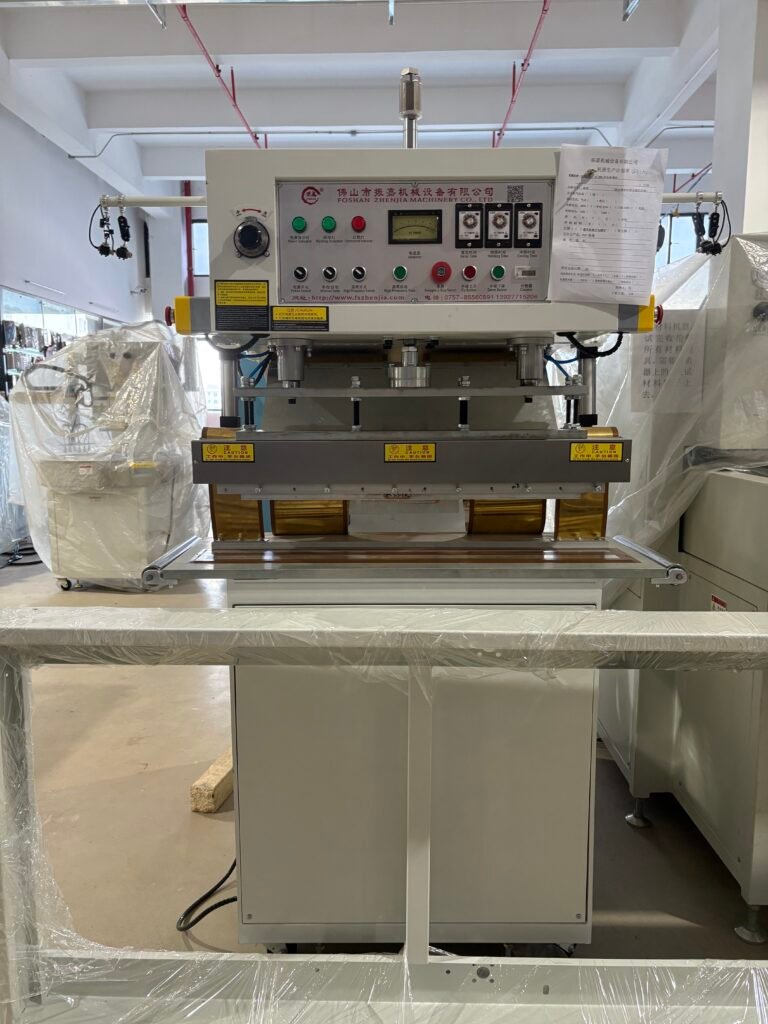
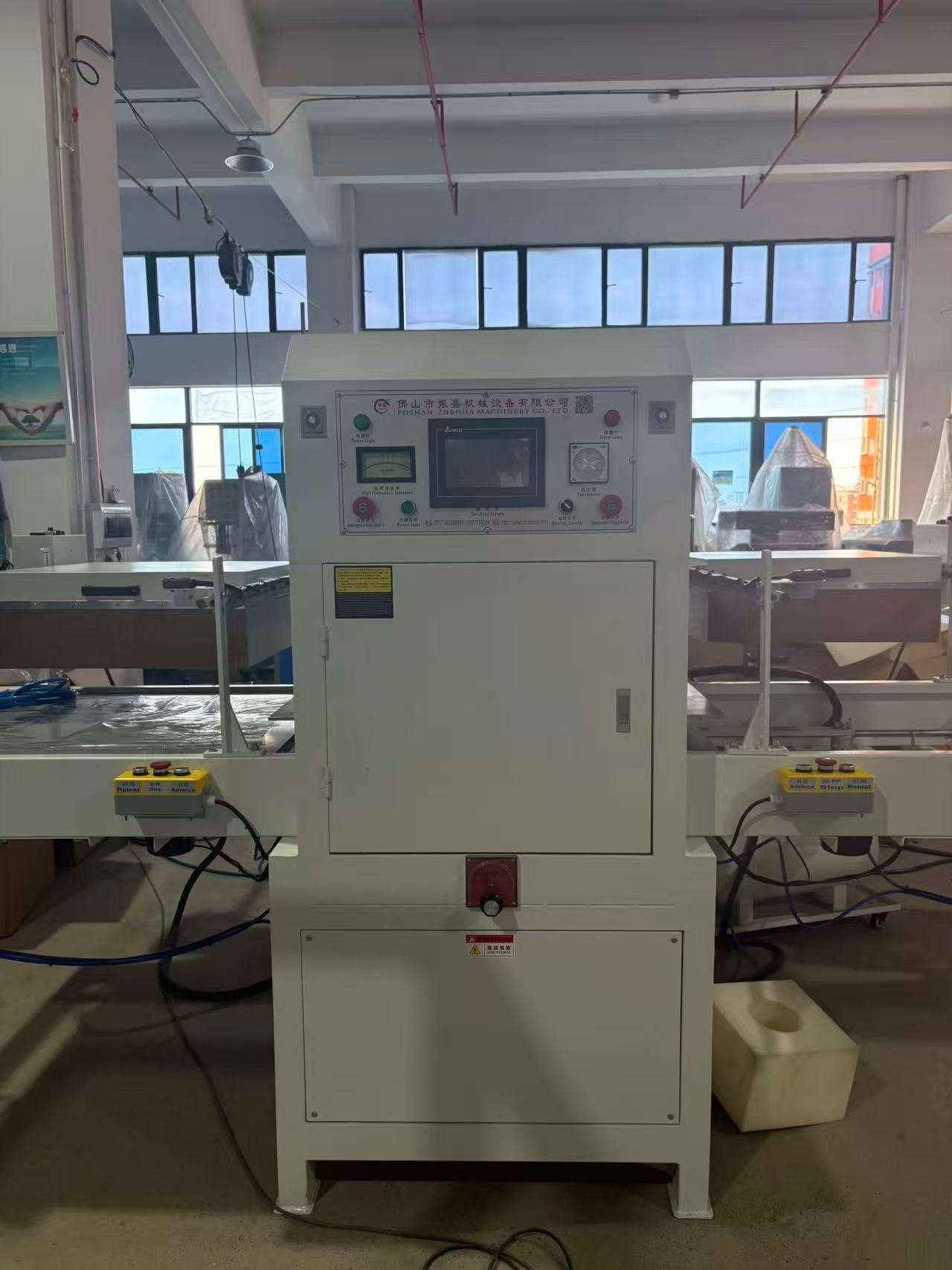
An Automatic HF Welding Machine configured with robotic part handling addresses these demands directly. The operator loads material rolls or stacks into the feeding system. The machine takes over from there, positioning the material, executing the weld, and ejecting finished parts onto an outfeed conveyor. One operator oversees multiple cells. Quality data logs capture every cycle parameter for the traceability that automotive OEMs require.
A Shuttle HF Welding Machine fills the gap for products that need a human in the loop but still demand high throughput. Battery module sleeves and larger interior panels benefit from the overlapping workflow that a shuttle table provides. The operator loads one table while the other welds. There is no idle time waiting for the press to open. This configuration boosts output by roughly 40% compared to a single-station manual machine without the full complexity of robotic automation.
Solid state generators dominate new EV-related HF installations. The predictable energy delivery and automatic tuning prevent the power fluctuations that could compromise a battery pouch seal. The elimination of oscillator tube replacement also suits the low-maintenance philosophy of EV factories, where planned downtime windows are measured in hours per year, not days.
The EV-HF Connection Will Only Deepen
Electric vehicle architectures continue to evolve. Solid-state batteries, when they arrive, will require even more demanding sealing solutions. Higher voltage architectures above 800 volts will push cable insulation requirements further. Recyclable mono-material interiors, a growing sustainability goal, often rely on welded instead of glued assemblies to simplify end-of-life material recovery.
Each of these trends reinforces the HF welder demand EV industry trajectory. What started as a niche application for sealing a few battery pouches has grown into a core enabling technology for the entire electric vehicle platform. Manufacturers who understand this connection position themselves to grow with the industry. Those who ignore it find themselves locked out of supplier qualification lists.
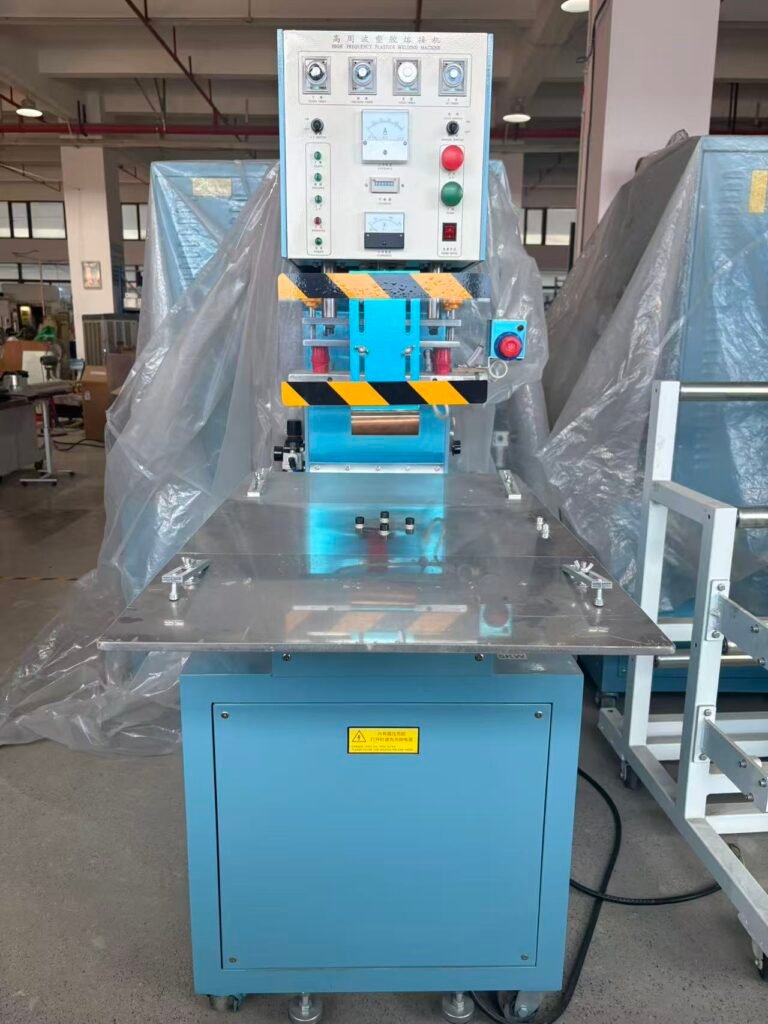
A high frequency welding machine sitting on an EV battery line looks different from one in a stationery factory. The power rating is higher. The automation level is deeper. The data logging is more comprehensive. But the underlying physics is identical. RF energy fuses polar thermoplastics into permanent, hermetically sealed joints. That timeless capability now helps propel millions of zero-emission vehicles down the road. The partnership between dielectric welding and electric mobility has only begun.