 TEL +86-13923172919
High Frequency Blister Sealing Machine: How It Seals PVC and PETG Packaging Every Time
Blister packaging fails at the seal. Everything else — the formed cavity, the printed card, the product inside — is secondary if the weld line opens under stress or lets moisture through. A high frequency blister sealing machine produces seals that consistently outperform heat-contact alternatives because the fusion happens inside the material, not on its surface.
This guide explains exactly how HF blister sealing works, why PVC and PETG behave differently under the same electromagnetic field, what the die design determines about your finished package, and how to match the machine format to your production volume.
How a High Frequency Blister Sealing Machine Works
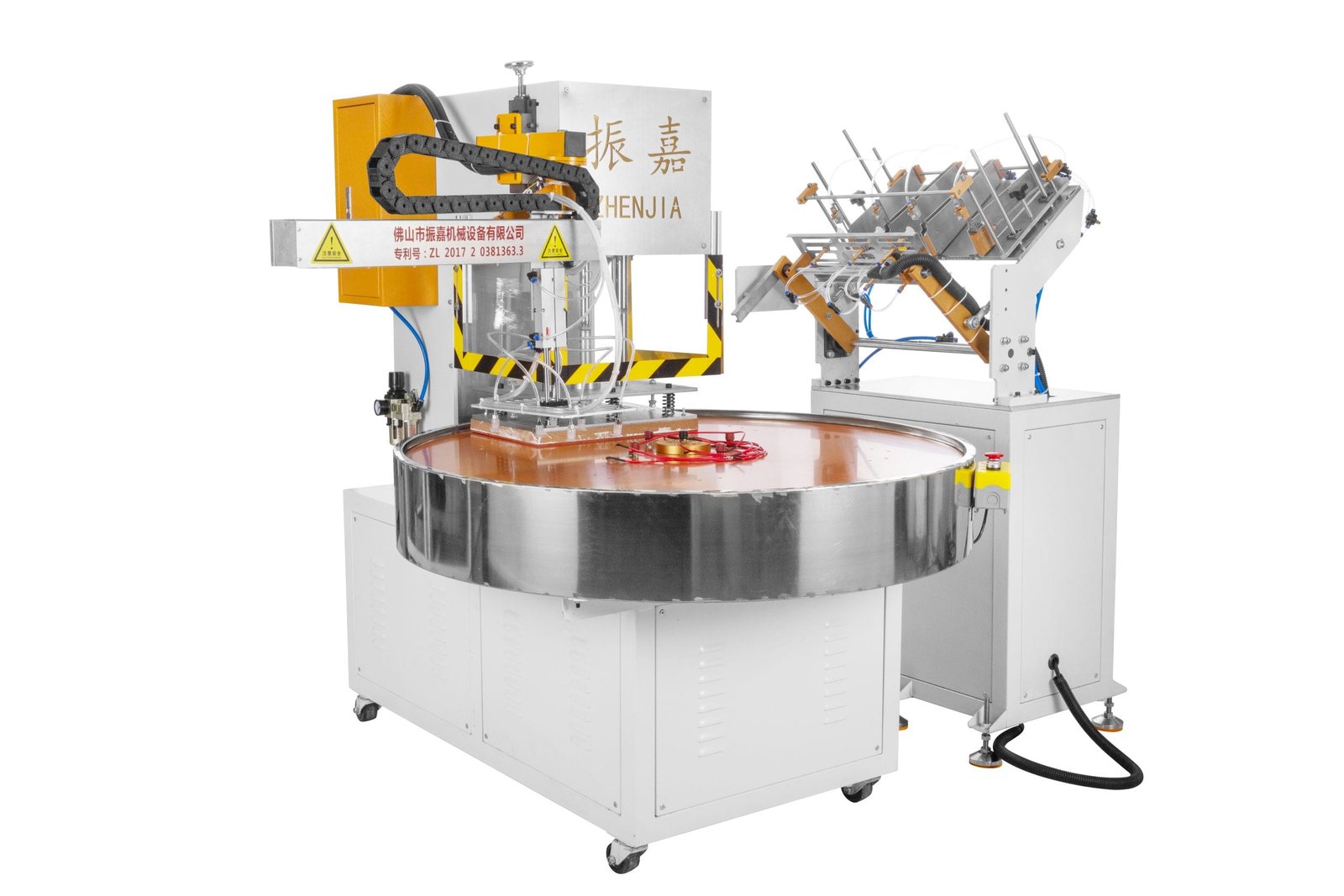
A high frequency blister sealing machine uses electromagnetic energy at 27.12 MHz to generate heat inside the flange area of a plastic blister. No external heat source contacts the material. Instead, the machine creates an alternating electromagnetic field between two metal electrodes — the upper die and the lower table. The field passes through the plastic material positioned between them.
Polar molecules inside the PVC or PETG respond to this alternating field by attempting to align with it. The field reverses 27.12 million times per second, far faster than the molecules can follow. This lag between field direction and molecular orientation creates friction inside the material — friction that generates heat. The temperature rises from the inside out, reaching the fusion point in the narrow band where the two flange layers contact each other.
At the same time, the pneumatic press drives the upper electrode down onto the clamshell flange with controlled force. The combination of internal heat and external pressure fuses the two plastic layers at the molecular level. When the generator switches off, the press holds pressure while the fused zone solidifies. The result is a seamless, homogenous seal — the same molecular structure as the original material, with no adhesive residue, no stitching, and no surface damage to the transparent areas of the blister.
This is the fundamental difference between HF blister sealing and conventional heat-contact sealing. Heat-contact methods apply temperature from the outside in. The surface heats first and risks burning or deforming before the interior reaches fusion temperature. HF sealing concentrates energy at the interface between the two layers — exactly where the seal needs to form — while the outer surfaces stay relatively cool against the metal electrode.
PVC Blister Packaging: Why It Is the Easiest Material to HF Weld
PVC dominates blister packaging globally, and the reason traces directly to its molecular structure. And PVC contains chlorine atoms distributed asymmetrically along the polymer chain. This asymmetry creates a strong permanent dipole — a molecule with a positively charged end and a negatively charged end. That dipole responds powerfully to the alternating electromagnetic field, absorbing energy efficiently and converting it to heat quickly.
In practical production terms, this means PVC welds at moderate power settings, tolerates a relatively wide range of parameters, and produces consistent seals even when minor material variation exists between rolls. The TWI HF Welding Handbook describes PVC as “relatively tolerant” of parameter variation compared to other materials — a quality that makes it forgiving for operators and reliable on high-speed production lines.
For blister packaging, flexible PVC is the standard choice for most consumer goods applications: hardware packs, batteries, toys, cosmetics, stationery, and retail electronics. It thermoforms easily into complex blister shapes, cuts cleanly, denests well from stacked trays, and accepts a wide range of print coatings on the backing card.
The machine settings for sealing flexible PVC blister flanges are straightforward. A 5 kW to 8 kW HF blister sealing machine handles the majority of standard consumer packaging applications. Weld times in the range of 1 to 3 seconds are typical for flange widths between 3 mm and 8 mm on standard flexible PVC in the 0.3 mm to 0.5 mm thickness range. Power should start at a medium setting and be adjusted upward in small increments while running test seals until the flange fuses completely without surface discoloration.
One material consideration worth noting: not all PVC films are formulated for RF welding. Films intended for print applications, lamination, or general thermoforming may contain plasticizers or stabilizer packages that reduce their dielectric loss factor or leave surface residue that interferes with sealing. Always specify RF-weldable grade PVC from your film supplier and confirm compatibility with a test weld before committing to production tooling.
PETG Blister Welding: The PVC Alternative That Works on the Same Machine
PETG — polyethylene terephthalate glycol — is the most widely used PVC alternative for RF blister sealing. The glycol modification lowers its melting point compared to standard PET and gives it properties that closely parallel PVC: good thermoformability, excellent optical clarity, and — critically — sufficient dielectric loss properties to support HF sealing on standard equipment.
The PETG is increasingly specified in packaging where regulatory restrictions on PVC are a concern. Many retailers in Europe and North America have sustainability programs that push suppliers toward non-PVC packaging. PETG meets these requirements while remaining compatible with HF blister sealing machines, which means manufacturers can switch material without switching equipment.
The sealing behavior of PETG differs from PVC in a few important ways. PETG has a lower dielectric loss factor than PVC, meaning it absorbs less energy per unit time at equivalent field strength. In practice, this means PETG typically requires slightly higher power settings or longer weld times than PVC at identical flange geometry and thickness. The difference is not dramatic — most HF blister sealing machines handle both materials without hardware modification — but operators must recalibrate parameters when switching between them rather than assuming PVC settings will transfer directly.
PETG also benefits from heated electrode platens more than PVC does. Pre-warming the upper electrode to a controlled temperature — typically in the range of 40°C to 80°C depending on the machine specification — stabilizes the thermal baseline at the flange surface and improves seal consistency, particularly at the start of a production run before the electrode has warmed naturally from cycle repetition.
相关产品


APET and GAG: Extending the Material Range
APET (amorphous PET) and GAG (a PETG/APET/PETG sandwich laminate) are commonly specified in retail and food-grade packaging alongside PETG. Both are RF-weldable to varying degrees.
APET has higher strength and better dimensional stability than PETG but requires more precise process control for consistent HF sealing. Its narrower processing window means power, pressure, and weld time must be calibrated more carefully. Heated electrode platens become more important with APET — cold-start welds on APET without platen preheating frequently produce incomplete seals at the flange corners where material mass is lower.
GAG combines an outer PETG skin with an APET core. The PETG skin responds to the HF field similarly to standard PETG sheet, making GAG easier to seal consistently than pure APET while offering the structural rigidity benefits of the APET core. GAG is widely used in retail clamshells for electronics, hardware, and personal care products where both display clarity and package rigidity matter.
For all three material families — PVC, PETG/GAG, and APET — the same HF blister sealing machine handles each by adjusting power output, weld time, cooling time, and optionally electrode temperature. This material flexibility is one of the key commercial advantages of HF technology over hot-plate or impulse sealing methods, which typically require different tooling and temperature systems for different plastic families.
Blister Package Formats and What Each Requires from the Machine
The machine configuration and die design requirements change significantly depending on which blister format you are producing. Understanding the differences prevents mismatches between machine capability and packaging requirements.
Clamshell (Plastic-to-Plastic)
A clamshell is a fully plastic package — both halves are thermoformed from the same material, hinged at one edge, and sealed along the remaining three sides. No backing card is involved. The HF blister sealing machine fuses plastic flange to plastic flange directly.
Clamshells are the most demanding format for HF sealing because both sealing surfaces are plastic and must fuse to each other cleanly. The die must contact the flange on both sides simultaneously with even pressure. Die design is critical — any deviation in flange height or flatness between the two halves creates inconsistent contact and produces seal voids.
PVC clamshells for retail consumer goods — batteries, lipstick, hardware items — represent the largest single application category for HF PVC clamshell welding machines. PETG and GAG clamshells are increasingly common in the same product categories as PVC alternatives.
Blister and Card (Plastic-to-Cardboard)
In this format, a thermoformed plastic blister is sealed to a printed backing card. The card carries a heat-seal coating on the contact surface that activates under heat and pressure to bond the plastic blister flange to the card.
The HF field heats the plastic blister flange from within. The heat conducts through the flange surface into the card coating, activating the adhesive layer. The result is a hermetic seal between the plastic and the card without requiring external heat from a hot plate.
This format requires slightly different die geometry than plastic-to-plastic sealing. The die must support the card flat against the blister flange without distorting the card surface or crushing the cavity underneath. Card selection matters — the coating must be compatible with HF-driven thermal activation, which differs from the direct contact heat applied by a hot plate sealer.
Double-Sided Blister (Plastic-to-Plastic Sandwich)
A double-sided blister uses two thermoformed halves that sandwich the product, often with a hanging tab formed into the flange. The two halves may be oriented identically (symmetric) or mirrored (asymmetric). The HF machine seals all four edges simultaneously when the die is designed to contact the full perimeter flange.
Double-sided blisters require the most precise die fabrication of any blister format because the perimeter seal must be consistent at every point — including the corners, where material mass transitions and stress concentrations increase the risk of seal voids.
Die Design: What Determines Seal Quality
The welding die — also called the sealing mold or electrode — is the component that defines the final seal profile. Die design is as important as machine power and parameters in determining seal quality. A well-parameterized machine with a poorly designed die produces consistently poor seals.
- Flange contact geometry. The die contact surface must match the actual flange geometry of your blister — both width and height. Flanges are typically 3 mm to 8 mm wide for consumer packaging. Wider flanges produce stronger seals and are more forgiving of minor positioning variation. Narrower flanges reduce material usage but require more precise alignment and tighter parameter control.
- Seal-and-cut edge design. Many HF blister sealing dies incorporate a raised rim around the perimeter of the sealing face. This rim concentrates pressure and electromagnetic field intensity at a narrow line at the outer edge of the flange, simultaneously sealing the plastic and cutting through it in a single press cycle. This seal-and-cut configuration eliminates a separate trimming step, reduces material waste at the flange, and produces a clean, defined package edge in one operation.
- Die material. Brass dies require approximately 25% less RF power than equivalent aluminum dies because brass has a higher electrical conductivity and transfers energy to the material more efficiently. For high-volume blister production where running cost matters, brass tooling reduces energy consumption per cycle. Aluminum dies cost less to fabricate and are suitable for lower-volume or prototype applications where maximum energy efficiency is a secondary concern.
- Corner radius. Blister flange corners concentrate stress and often produce the first seal failures in a package. Die corners should be radiused rather than sharp to distribute pressure evenly at the transition points. A corner radius of 2 to 4 mm is typical for consumer packaging flanges.
- Cavity clearance. The die must clear the blister cavity completely — the shaped dome of the blister must sit below the lower table surface or in a cutout in the die mount so the electrode contacts only the flat flange. If the cavity contacts the electrode or the die frame, the seal will be uneven and the cavity may deform.
Machine Types for Blister Sealing: Matching Format to Volume
HF blister sealing machines come in three principal configurations. The right choice depends on your production volume, product mix, and level of automation required.
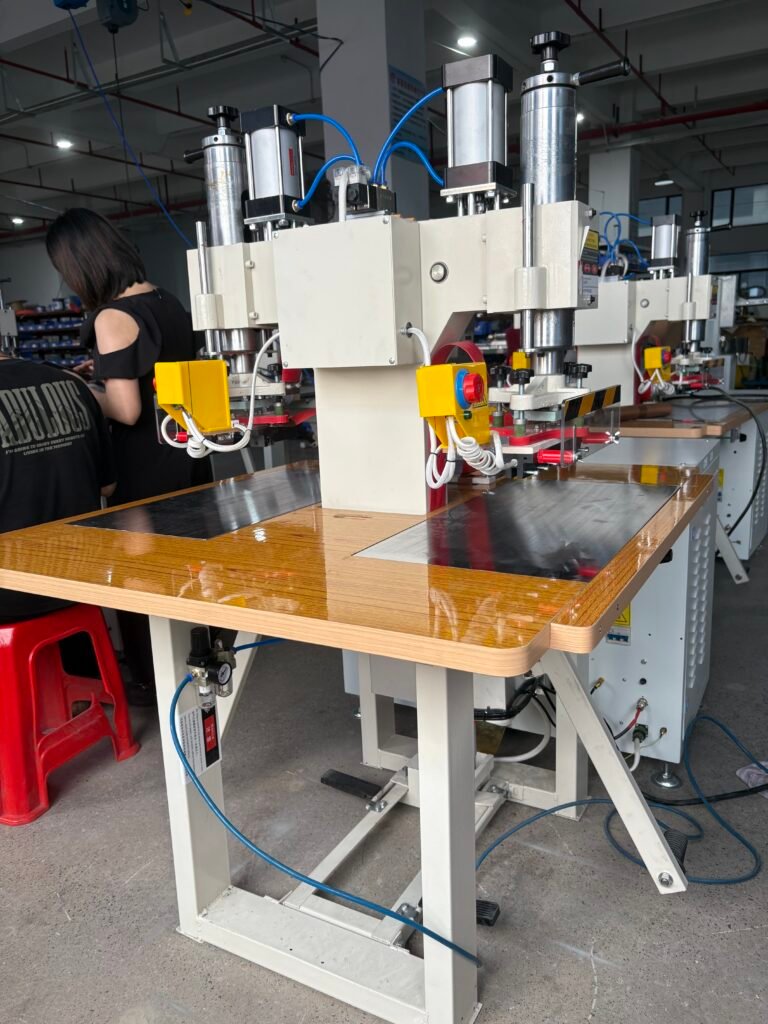
Manual push plate or sliding table machine. The operator places the blister and card by hand on a flat work surface, positions them under the die, and activates the cycle. These machines suit small-batch production, prototype development, and operations with frequent product changeovers. Output is limited by the operator’s loading speed. A typical manual machine produces 300 to 600 cycles per 8-hour shift on standard consumer blisters.
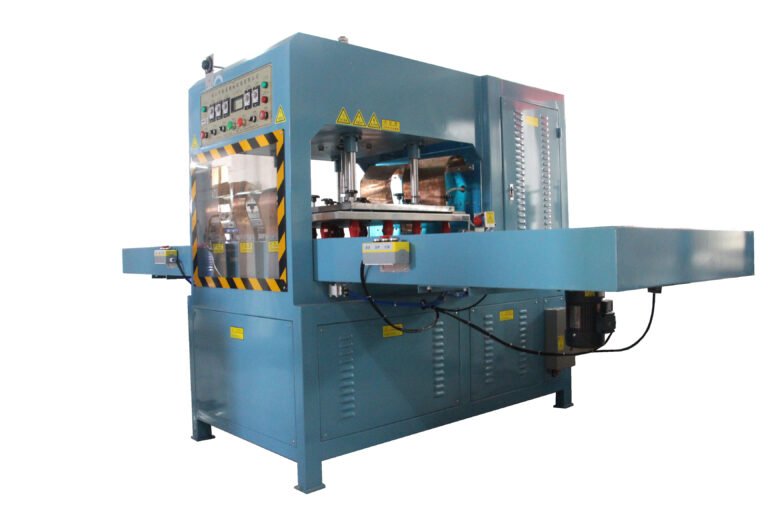
Shuttle (double-station) machine. Two work trays alternate between the loading position and the welding position. While one tray welds, the other loads. The generator runs almost continuously. Output roughly doubles compared to a manual machine running the same product. Shuttle HF blister sealing machines are the standard choice for medium-volume blister production and for applications requiring precision flat-surface die positioning — such as blister-to-card sealing where card alignment is critical.
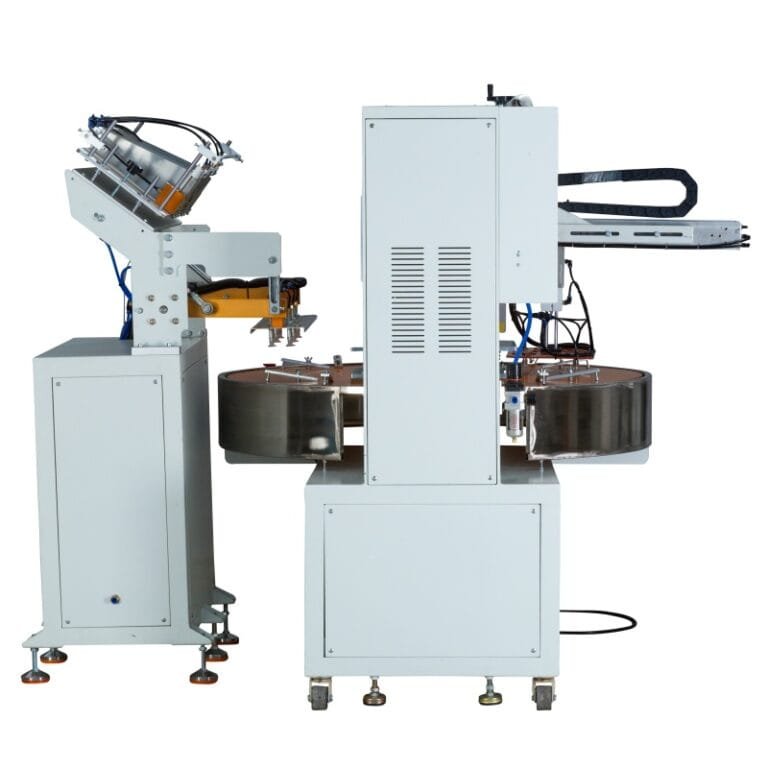
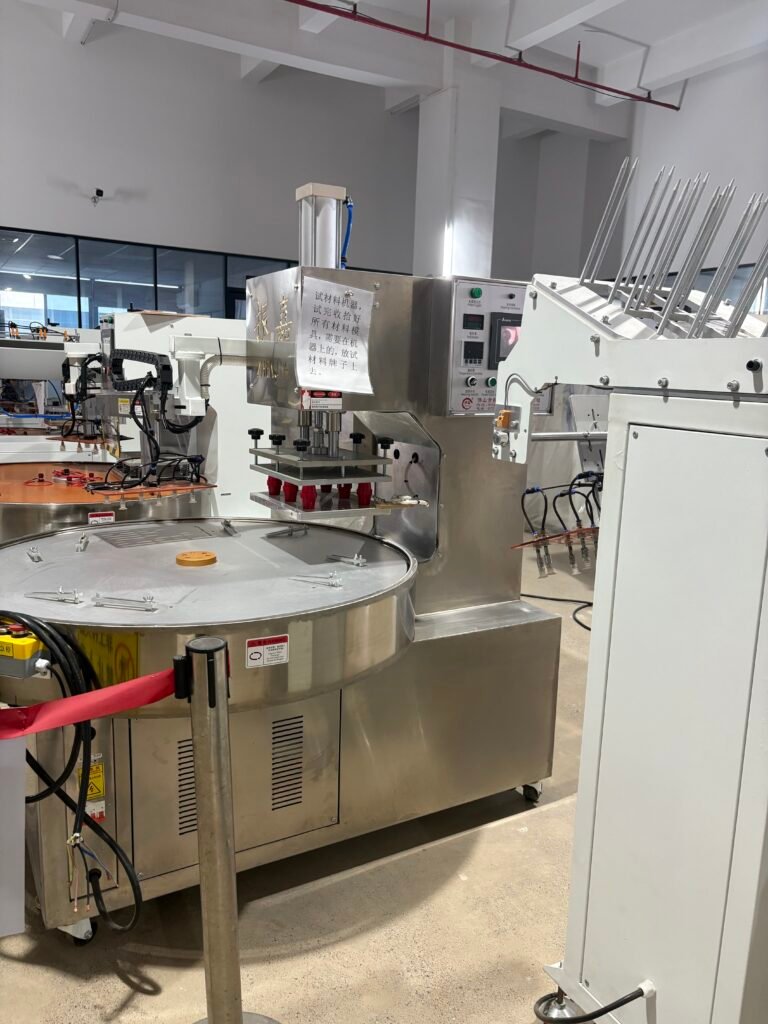
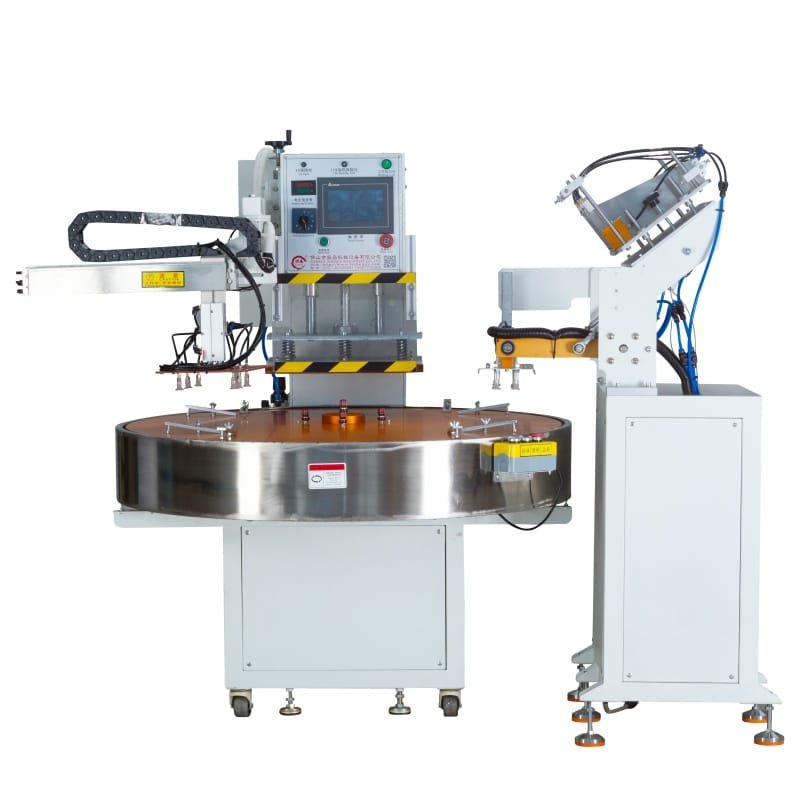
Rotary turntable machine. Four to eight stations rotate continuously under the electrode. Loading, welding, cooling, and unloading happen simultaneously at different stations. Output can reach 3,000 to 5,000 cycles per shift for compact consumer blisters on a well-configured rotary machine. This format suits high-volume, single-product or limited-SKU production runs where the investment in tooling for each station is justified by volume. Rotary HF blister sealing machines are the dominant format in high-volume stationery, battery, and cosmetics packaging.
Key Features to Look for When Buying an HF Blister Sealing Machine
- Adjustable weld and cooling time. Both parameters must be independently programmable. Machines that control only weld time without separate cooling time control cannot reliably produce consistent seals as the electrode temperature changes during production.
- Arc suppression circuit. A fast-acting spark protection system cuts HF power within milliseconds when arcing is detected. This is essential for blister sealing — the thin flanges, die edges, and occasional material misalignment all create arcing risk. An arc suppressor prevents die damage and material burns that would otherwise destroy the product and require costly die reconditioning.
- Optional heated electrode platen. For PETG, APET, and rigid PVC applications, a temperature-controlled upper platen significantly improves seal consistency. Look for machines that offer this as a standard or optional feature if you plan to seal these materials.
- Quick-change die holder. Production lines that run multiple SKUs need to change dies frequently. A quick-release die mounting system reduces changeover time from 30 to 60 minutes to under 10 minutes, directly improving line utilization.
- PLC with recipe storage. A programmable controller that stores named parameter sets for each product eliminates the need to re-establish settings from scratch on every job change. This is essential for consistent quality across shifts and operators.
- Power output matched to your die area. The correct power level depends on the sealing area of your die. A widely cited reference point is approximately 250 to 300 watts of HF power per 3-second seal cycle for standard 0.3 mm flexible PVC on a small die area. Scale this proportionally upward for larger flanges or thicker material. A 5 kW machine handles most standard consumer blister applications. An 8 kW machine suits larger blisters, thicker PETG, or heavier clamshell formats. Machines above 10 kW are used for large-format or multi-cavity dies running simultaneously.
Frequently Asked Questions
Can the same HF blister sealing machine weld both PVC and PETG?
Yes. PVC and PETG are both RF-weldable on the same machine. PETG requires slightly higher power or longer weld time than PVC at comparable thickness and flange geometry. If the machine includes a heated electrode platen, enabling it for PETG production improves seal consistency. No hardware changes are required — only parameter adjustment and test welding when switching materials.
What is the difference between HF blister sealing and heat-contact sealing?
Heat-contact sealing applies temperature from a heated plate directly to the plastic surface. It heats from the outside in, which risks surface burning before the interior reaches fusion temperature, and produces seals whose strength depends on precise plate temperature control. HF sealing generates heat inside the plastic at the flange interface — no external heat touches the surface. The result is cleaner seals, lower surface distortion risk, and better consistency across a production run as electrode temperature varies.
Why does my HF blister seal look good but peel open easily?
This typically means fusion is incomplete at the bond interface despite an acceptable surface appearance. The most common causes are insufficient weld time, power too low for the material and die area, or an unlevel die that produces uneven contact pressure across the flange. Check electrode leveling first — it is the most common overlooked cause. Then increase weld time in 0.5-second increments while running test seals until peel strength improves. Evaluate by pulling the flange apart at 180 degrees: a properly sealed blister tears the material before the seal opens.
What flange width is recommended for a strong clamshell seal?
A minimum flange width of 4 mm is generally recommended for consumer clamshell packaging. Wider flanges — 5 mm to 8 mm — provide more sealing surface area, greater tolerance for positioning variation, and better resistance to peel and tear forces in the finished package. Very narrow flanges below 3 mm are difficult to seal consistently and should be avoided unless product design constraints make them unavoidable.
Can an HF blister sealing machine weld APET without a heated platen?
It is possible but significantly more difficult. APET has a narrower processing window than PVC or PETG, and cold-electrode starts produce inconsistent results at the flange corners where material mass changes. Without platen heating, the operator must run several warm-up cycles at the start of each production session to bring the electrode to a stable working temperature before committing production material. Heated platen machines eliminate this variability and are strongly recommended for any regular APET production.
How many cycles per day can a rotary HF blister sealing machine produce?
Output depends on machine configuration, number of stations, and weld cycle time per product. A typical four-station rotary machine running a 3-second total cycle time indexes every 3 seconds, producing approximately 1,200 cycles per hour or roughly 9,000 to 10,000 cycles in an 8-hour shift. With eight stations and a compact product requiring a 2-second cycle, outputs of 14,000 to 15,000 cycles per shift are achievable. These are theoretical maximums — actual output is reduced by loading speed, material handling, and the first-in/first-out station timing buffer.