 TEL +86-13923172919
High Frequency Welding Machine for Shoe Uppers and Leather Goods: A Complete Production Guide
The footwear and leather goods industry demands joining methods that are fast, clean, and durable. Stitching leaves needle holes. Adhesive adds weight, VOC emissions, and a process step that depends heavily on application quality. A high frequency welding machine for shoes replaces both — bonding and embossing PVC and PU synthetic materials simultaneously, without glue, without thread, and without a separate decorating step.
This guide covers every aspect of HF welding in footwear and leather goods production: which materials respond to the process, what the machine does at each stage of upper assembly, how to choose between die types, and what parameters to set for consistent results.
Where HF Welding Fits in Footwear Production
HF welding enters the production sequence after cutting and before final assembly. It handles the operations that traditional factories assign to stitching, gluing, or screen printing — but faster and with a better surface result on synthetic materials.
Upper Panel Bonding
Synthetic leather uppers consist of multiple cut panels — toe cap, side wall, counter, tongue, and lining. On an HF welding machine for shoes, these panels are layered and pressed together with a shaped die. The electromagnetic field fuses the overlapping zones from the inside out. No adhesive. No drying time. No delamination risk in humid or hot conditions.
The bond is molecular — the same material structure as the surrounding panel. A correctly welded upper joint is stronger than the base material at the seam line. This is particularly important at high-stress points like the toe box and heel counter, where peel and tear forces are highest during use.
Logo and Emblem Bonding
HF welding bonds logos, emblems, and brand patches directly to the upper surface without adhesive. The die presses a TPU or PVC logo piece onto the fabric surface. The electromagnetic field heats the logo from within. The melted synthetic material flows between the fabric threads and bonds mechanically and thermally to the underlying structure.
This technique appears across major athletic brands. Nike, Adidas, and New Balance all use RF welding for logo application on certain upper constructions. The result is a bond that resists peeling through heat, UV exposure, and mechanical flexing far better than screen-printed or adhesive-applied logos.
Embossing and Surface Decoration
A high frequency embossing machine creates raised or recessed patterns — simulated stitching lines, brand logos, texture grids, anti-slip zones — directly in the PVC or PU upper surface. The die carries the pattern geometry. When pressed against the heated material, the pattern transfers permanently into the surface.
The embossed pattern is not printed or applied. It is formed into the material. It cannot wash off, fade, or delaminate. This makes HF embossing the preferred method for decorative features on sports shoes, luxury synthetic leather goods, and any product where surface appearance must survive sustained use.
Insole Fusing and Lining Bonding
HF welding fuses insole foam layers to backing materials, bonds lining fabric to upper panels, and seals edge reinforcements. For multi-layer constructions — EVA foam laminated to PVC outer, or PU foam bonded to jersey lining — the machine welds the full stack in a single cycle.
EVA and PU foams both accept HF compression. Under the right pressure and power settings, they compress without rebounding after the press opens — creating a flat, stable lamination that holds its form throughout the product’s life.
Heel Pull Tab and Label Welding
Heel pull tabs, size labels, brand tags, and reflective elements are all candidates for HF welding attachment. These small components are placed in position on the die, the machine runs a brief cycle, and the element bonds to the upper surface cleanly. The cycle is faster than equivalent sewing or adhesive operations and produces a neater result on synthetic materials.
Materials That Work — and Materials That Do Not
Material compatibility is the first qualification for any HF welding application. The footwear industry uses a wide range of synthetics. Not all of them weld the same way.
PVC Synthetic Leather
PVC-coated synthetic leather is the easiest material for PVC shoe upper welding. PVC has a high dielectric loss factor — it absorbs electromagnetic energy efficiently and heats quickly. Standard welding parameters work reliably across most PVC synthetic leather grades.
The PVC coating must be continuous and consistent across the contact zone. Printed or surface-coated PVC may need additional testing to confirm that the coating does not interfere with the bonding layer underneath.
PU Synthetic Leather
RF welding PU leather requires more attention than PVC. PU has a lower dielectric loss factor than PVC, meaning it absorbs energy more slowly. Higher power settings or longer weld times are needed to achieve the same fusion depth. The difference is manageable — most machines handle PU leather without hardware changes — but operators must recalibrate when switching from PVC-based materials.
PU-coated textiles work well when the PU layer thickness is sufficient to create a strong bond. Very thin PU coatings on mesh or knit fabrics may not carry enough material for reliable fusion. Test weld samples before committing to production tooling.
TPU Film and Sheet
TPU (thermoplastic polyurethane) sheet and film is widely used for logo overlays, protective toe caps, and structural reinforcement panels on athletic shoes. HF welding TPU shoe logos is a standard operation in high-volume footwear manufacturing.
TPU has good dielectric properties and bonds readily to itself and to PU-coated fabric surfaces. Metallic TPU film — used for reflective logos and decorative accents — also welds well when the metallic layer is applied to the surface rather than mixed into the polymer.
EVA Foam
EVA (ethylene-vinyl acetate) foam responds to HF energy through its vinyl acetate content. The more vinyl acetate in the formulation, the better it welds. Standard shoe insole EVA at typical vinyl acetate contents welds acceptably for compression bonding and lining fusion operations. High-density EVA requires more power than standard grades.
Nylon-Coated and Mesh Fabrics
Pure nylon does not weld directly under HF energy without preheating. However, nylon mesh fabrics with a PU or PVC laminate bond well when the welding force is directed through the thermoplastic layer. The mesh structure accepts the melted polymer between its threads, creating a mechanical interlock that reinforces the thermal bond.
Natural Leather
Genuine leather does not weld. It is not a thermoplastic and does not respond to the electromagnetic field. HF compression can create surface embossing on leather by pressing a heated die into the surface — this is a thermal forming operation, not welding. The die conducts heat from the electrode into the leather surface. Results are possible but require a machine with a heated platen option and precise temperature control. Most leather embossing operations in luxury goods use dedicated hot stamp presses rather than HF machines for this reason.
Two Die Types: Upper Press Die vs. Matched Mold
Die selection is the most consequential design decision in an HF welding shoe production setup. The die determines what operations the machine can perform, what surface quality it produces, and what complexity of shape it can achieve.
Upper Press Die (One-Sided)
An upper press die is a single metal plate — usually brass or aluminum — with the weld pattern machined or CNC-cut into its contact face. The die descends from above and presses into the flat upper surface. The lower table acts as the passive electrode.
Upper press dies work well for flat panel bonding, logo application, simulated stitching, and simple embossed textures. They are the standard choice for most shoe upper HF welding operations. CNC machining from flat brass sheet is the most common fabrication method. Brass machines with tighter tolerances than aluminum and requires approximately 25 percent less power for equivalent results due to its higher conductivity.
The limitation of the one-sided die is depth. It can emboss a surface pattern or apply a flat overlay, but it cannot create three-dimensional pockets, deep structural forms, or features that require material to be shaped on both sides simultaneously.
Matched Mold (Two-Sided)
A matched mold uses two die halves — upper and lower — that carry complementary geometry. When the press closes, the material is compressed between both surfaces simultaneously. This allows the creation of three-dimensional features: deep texture pockets, structural foam compressions, raised profile logos, and multi-layer forms with defined inner shapes.
Nike’s use of matched molds in Swoosh logo production is a documented example. The factory die-cuts flat TPU stock into the logo shape, then uses a matched HF mold to compress the TPU into its final three-dimensional form while simultaneously bonding it to the fabric upper. The matched die creates the 3D shape and completes the bonding in a single press cycle.
Matched molds cost significantly more than upper press dies. They require precise alignment between the two halves and more complex fixturing. But for products with defined three-dimensional surface geometry, they are the only way to achieve the required result in a single production step.
Die Material Selection
Brass dies are the standard choice for shoe upper HF welding. Brass machines cleanly, holds fine detail, and conducts the electromagnetic field efficiently — requiring approximately 25 percent less generator output than aluminum for the same weld area. It is also rust-resistant, which matters in humid factory environments.
Aluminum dies cost less and are appropriate for prototype work or products with simpler patterns where fine detail resolution is not critical. For high-volume production where die longevity and energy efficiency both matter, brass is worth the premium.
Some manufacturers apply PTFE (Teflon) coating to die surfaces that contact PVC or PU directly. The coating prevents material sticking to the die face after each cycle, reducing cleaning frequency and preventing surface marking on the finished product.
The Production Sequence: From Cut Parts to Finished Upper
Understanding where HF welding fits in the wider production flow helps manufacturers plan machine positioning, material flow, and labor allocation correctly.
Stage 1 — Cutting
Upper panels are cut to shape from roll stock or sheet material. Cutting precedes HF welding. The cut parts must be accurate — HF die alignment depends on consistent part geometry. Laser cutting or CNC clicker press cutting produces the tightest tolerances.
Stage 2 — Panel Preparation
Cut panels are cleaned and inspected before loading. Surface contamination — mold release agents from thermoforming, oil from handling, or moisture from storage — interferes with the weld. Clean panels with isopropyl alcohol and allow to dry completely. Moisture on the PVC surface is not always visible but causes pinholes and surface pitting in the finished weld.
Stage 3 — HF Welding and Embossing
Panels are placed on the machine work surface and positioned against alignment fixtures or stops. The die descends, the HF cycle runs, and the bond and any embossed pattern form simultaneously. The press holds closed during cooling. The part releases cleanly. The operator inspects the result and loads the next set of panels.
Complex uppers with multiple weld zones require the operator to reposition the panel between cycles for each zone. Fixturing design that allows fast, accurate repositioning is a significant productivity factor in this operation.
Stage 4 — Inspection and Trim
Welded panels are inspected for bond completeness, embossing depth consistency, and seam edge definition. Excess material at weld-and-cut seams is trimmed or already removed by the cutting edge built into the die. Weld-and-cut dies — which seal and trim the edge in a single press cycle — are common in upper production because they eliminate a separate trimming step.
Stage 5 — Assembly
Welded panel assemblies proceed to the lasting, sole bonding, and final assembly stations. The welded zones arrive with consistent geometry and surface finish, reducing adjustment work at downstream stations compared to sewn or glued assemblies where seam thickness and alignment vary between pieces.
Machine Selection for Shoe and Leather Goods Production
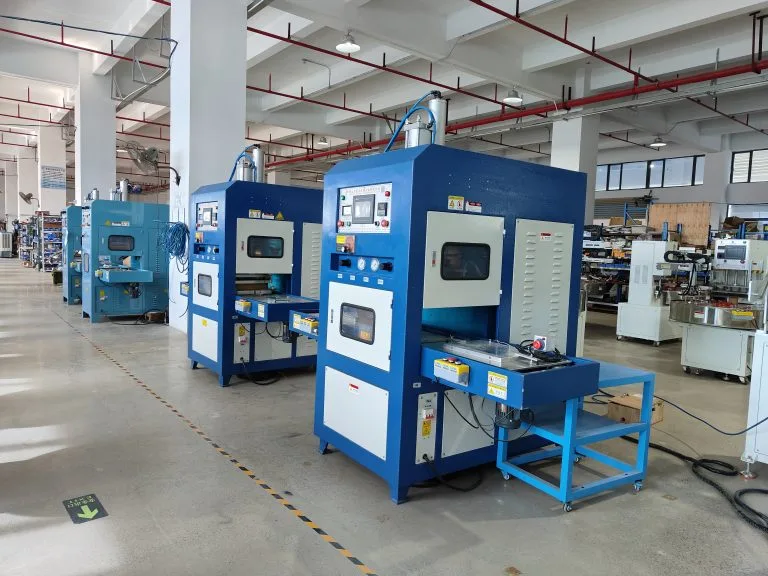
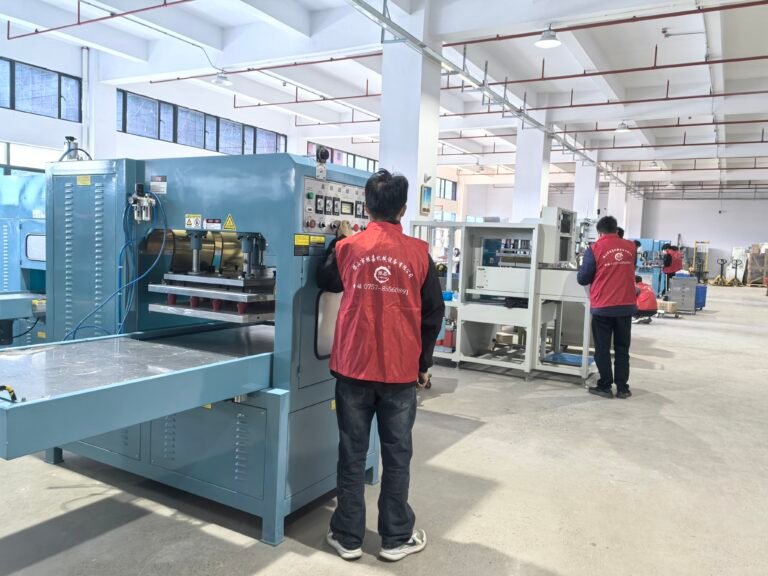
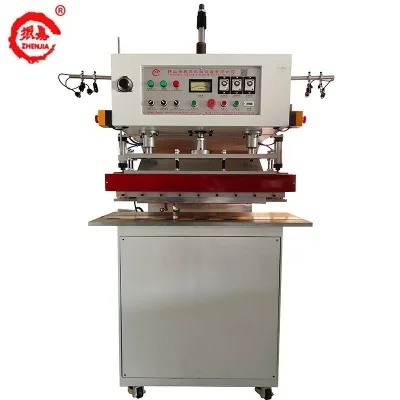
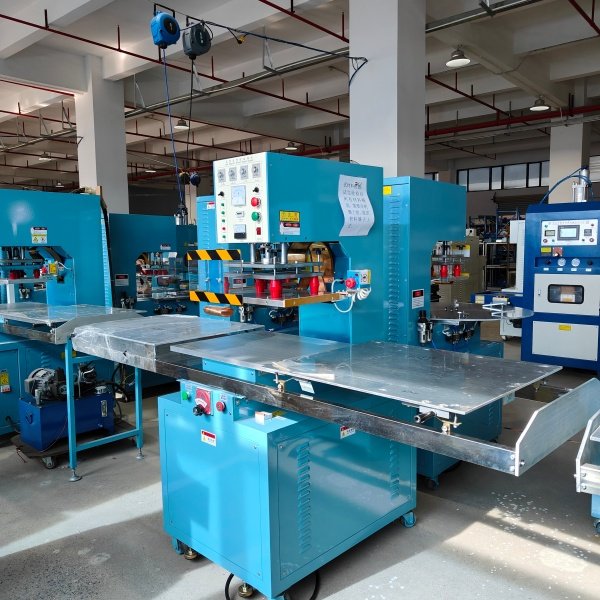
Most shoe upper and leather goods HF welding operations use push plate machines — single-station presses that the operator loads directly. The reasons are practical.
Why Push Plate Machines Dominate This Application
Shoe upper components are small relative to the machine work surface. A single upper panel section fits easily within the die area of a standard push plate machine. The production volumes per style in footwear are often moderate — a few hundred to a few thousand pairs per run — and the product mix changes frequently between styles and seasons.
Push plate machines handle frequent die changeovers faster than shuttle or rotary configurations. A new die set installs in minutes. The operator can work through multiple different logo, seam pattern, or embossing operations on the same machine in a single shift simply by swapping dies between cycles.
Power Requirements
For standard PVC or PU upper panel bonding with die areas covering a single upper zone, an 8 kW machine handles most operations comfortably. Larger dies covering full panel sections require more power — 12 kW to 15 kW covers most single-upper-section welding at these larger scales.
Logo welding and small embossing operations use less power because the die contact area is small. A 5 kW machine is sufficient for dedicated logo and emblem bonding applications where the die covers only the logo area — typically 10 to 30 cm².
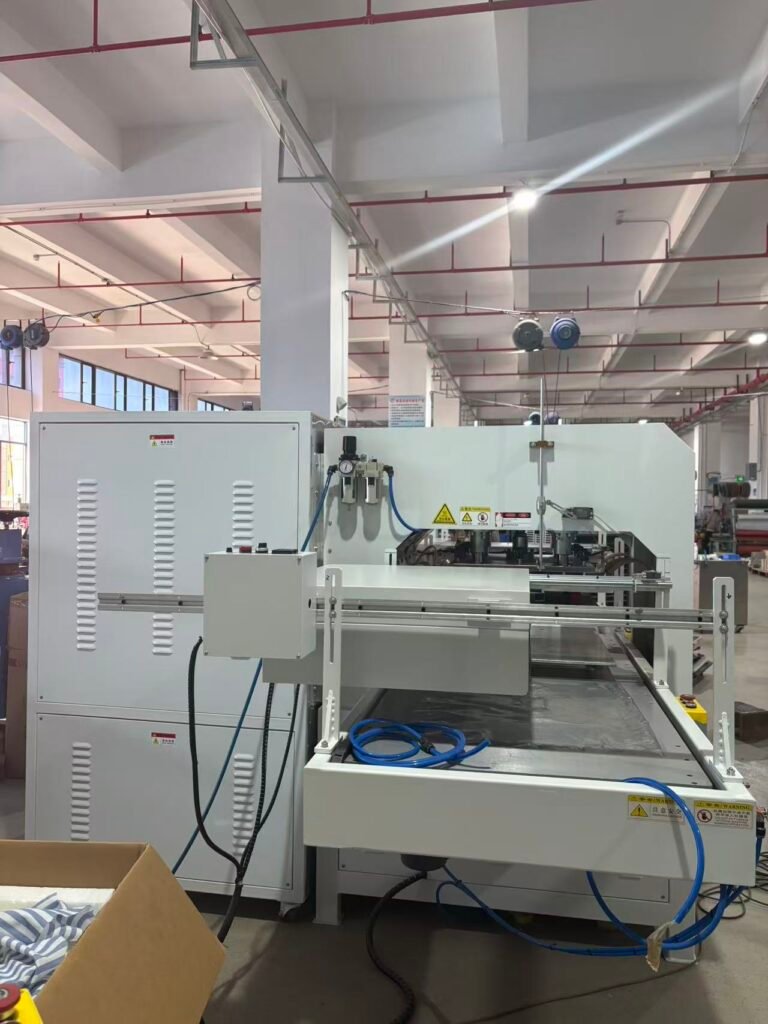
Matched mold operations that compress thick foam layers or bond multi-layer stacks need higher power and often higher press force than single-surface upper welding. A 15 kW machine with hydraulic press capability handles the most demanding matched mold shoe production applications.
Leather Goods: Bags, Wallets, and Accessories
Handbags, wallets, card holders, luggage panels, and fashion accessories use HF welding for the same operations as footwear — panel bonding, logo application, and surface embossing on PVC and PU synthetic materials.
HF welder leather goods production typically uses the same push plate machine configuration as shoe upper work. The die geometries differ — bag gusset seals, handle attachment zones, and panel edge bonding require different die profiles — but the machine format and parameter ranges are comparable.
High-end leather goods brands use HF embossing to create signature surface textures — crocodile scale patterns, woven grid textures, and brand logo embosses — on PVC and PU materials. The precision of the HF embossing machine creates patterns with consistent depth and definition that manual hot stamp or heat press methods cannot match reliably at production scale.
Common Setup Problems and How to Avoid Them
Sticking to the Die
PVC material sticking to the die surface after each cycle is the most frequent complaint in shoe upper HF welding. The causes are straightforward: power too high, cooling time too short, or no PTFE coating on the die face. Reduce power first. Extend cooling time by one to two seconds. If sticking persists, apply PTFE release spray to the die surface or have the die face coated.
Pattern Not Transferring Fully
Incomplete embossing pattern transfer — areas of the die that leave shallow or missing impressions — usually indicates insufficient pressure or uneven die leveling. Check die leveling first, then increase press pressure in small increments while running test pieces. If the pattern still transfers unevenly, inspect the die face for damage or debris in the pattern grooves.
Bond Too Weak at Panel Edges
Weak bonding at the die perimeter — while the center welds correctly — is almost always a die alignment or pressure distribution problem. The die is contacting the center of the material more firmly than the edges, either because it is unlevel or because the material surface is not perfectly flat. Check leveling, confirm the backup material is in good condition, and ensure the upper panel is fully flat against the work surface before the press closes.
Surface Burning on PU Leather
PU leather is more susceptible to surface burning than PVC because it has a lower thermal degradation threshold. If the surface shows yellowing or glossy burn marks at the weld edge, reduce power first. If burn marks persist at lower power, shorten weld time and verify that the die temperature has not built up excessively during continuous production. Allow the die to cool between batches if surface burning appears after the first 20 to 30 cycles.
Frequently Asked Questions
Can an HF welding machine bond PU leather to fabric without adhesive?
Yes, when the fabric carries a thermoplastic laminate — PU coating or PVC backing — that responds to the electromagnetic field. The melted thermoplastic layer flows between the fabric threads and creates a mechanical bond reinforced by thermal fusion. Pure cotton, polyester, or nylon fabric without any thermoplastic component cannot be HF welded. The thermoplastic layer must be present on at least one bonding surface.
What is the difference between HF welding and HF embossing on shoe uppers?
HF welding joins two or more material layers by fusing them together at the contact surface. HF embossing forms a surface pattern into a single material layer — or simultaneously while welding. Most shoe upper operations combine both in a single cycle: the die welds the panel overlap while its surface pattern embosses the material. The same machine performs both operations simultaneously.
Why use brass dies instead of aluminum for shoe upper production?
Brass dies require approximately 25 percent less generator power than aluminum dies of the same geometry because brass has higher electrical conductivity and transfers energy to the material more efficiently. Brass also machines to finer detail — important for brand logo dies and fine texture patterns. For high-volume production where die longevity and energy cost matter, brass delivers better value over the production life of the tooling despite its higher initial fabrication cost.
Can the same HF welding machine for shoes handle both upper welding and logo bonding?
Yes. The machine is the same — the difference is the die. Upper panel welding uses a larger die covering the weld zone of the panel section. Logo bonding uses a smaller die sized to the logo geometry. Operators switch between dies between operations. Most shoe factories run both operations on the same machine in sequence, grouping logo bonding cycles at the end of each style run to minimize die changeover interruptions to the main upper welding production flow.
What power range does a leather goods RF welding production setup typically require?
For handbag panel bonding and wallet seam welding, an 8 kW machine handles most operations. Small accessory work — card holders, key fobs, luggage tags — runs on 5 kW equipment. Large handbag constructions with full-panel die coverage at wider seam widths may require 12 kW. Embossing-only operations without simultaneous welding use less power than combined weld-and-emboss cycles and can typically run on the lower end of this range regardless of die area.