 TEL +86-13923172919
How Much Power RF Welding Machine: Choosing HF Welder Output Power Through Simple Area-Based Calculations and Application Matching
A machine with too little power never reaches welding temperature. The operator extends the cycle time, hoping more seconds will compensate for missing kilowatts. They do not. The material warms but never fully fuses. The seams peel apart. Production slows to a crawl while the generator runs at full output, delivering heat to the cooling water instead of the product.
A machine with too much power burns material the moment the cycle starts. The operator reduces the power setting to a fraction of the rated output and hopes the control resolution at 10% is as fine as it is at 80%. It rarely is. The oversized machine cost more to buy, takes up more floor space, and draws higher standing electrical loads for no production benefit.
Correct high frequency welding machine power selection sits precisely between these two failures. The machine delivers enough energy to melt the full weld area quickly without pushing any component beyond its thermal limit. This guide provides the calculation method that determines how much power RF welding machine your product actually needs. It also maps common power ratings to their appropriate applications.
The Fundamental Calculation: Weld Area Determines Power Demand
High frequency welding heats a volume of material. The generator must deliver enough watts per square millimeter of seal area to raise that volume from room temperature to the melting point and supply the latent heat of fusion. A simple multiplication gives the starting point for HF welder kW requirements.
Measure the total weld area. This is not the product area. It is the area of the sealing edges only. Multiply the total length of all seals on a single part by the weld width. A rectangular pouch with a 200-millimeter perimeter seal and a 3-millimeter wide weld has a weld area of 600 square millimeters. A multi-cavity die making four of these pouches per cycle has a total weld area of 2,400 square millimeters.
Multiply the total weld area by the material thickness factor. Thicker materials demand more energy to heat through. The power requirement increases roughly linearly with thickness. A 0.5-millimeter film stack requires approximately 0.8 to 1.2 kilowatts per 1,000 square millimeters of weld area. A 2.0-millimeter stack requires 3 to 5 kilowatts per 1,000 square millimeters.
Apply the material factor. PVC welds efficiently and serves as the baseline with a factor of 1.0. PU and TPU require 1.2 to 1.4 times the power of PVC for the same area and thickness. EVA, with its lower melting point, requires only 0.6 to 0.8 times the PVC baseline. Nylon and PET with preheating demand 1.5 to 2.0 times the baseline.
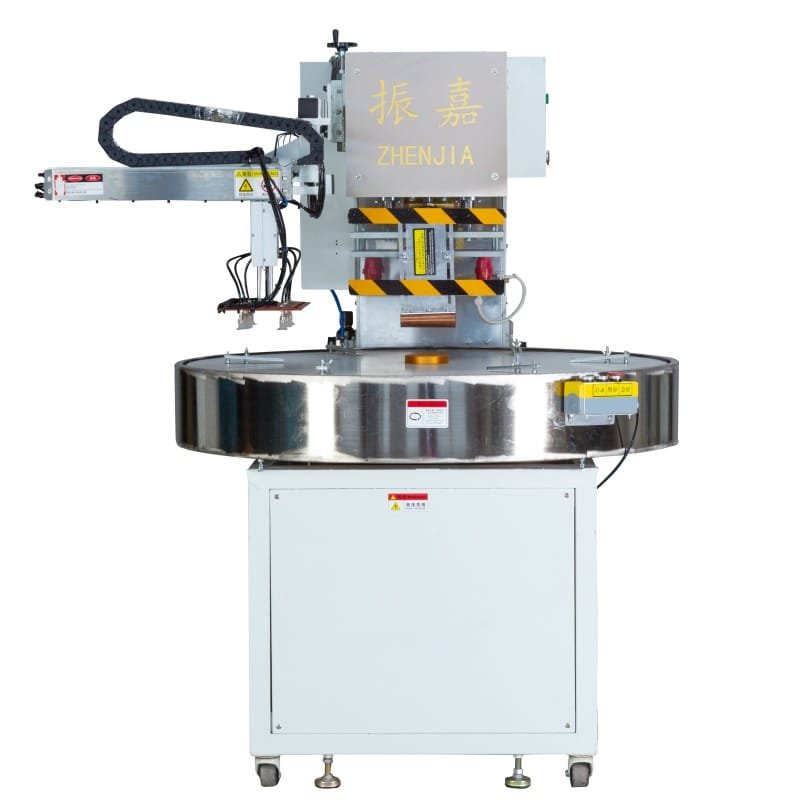
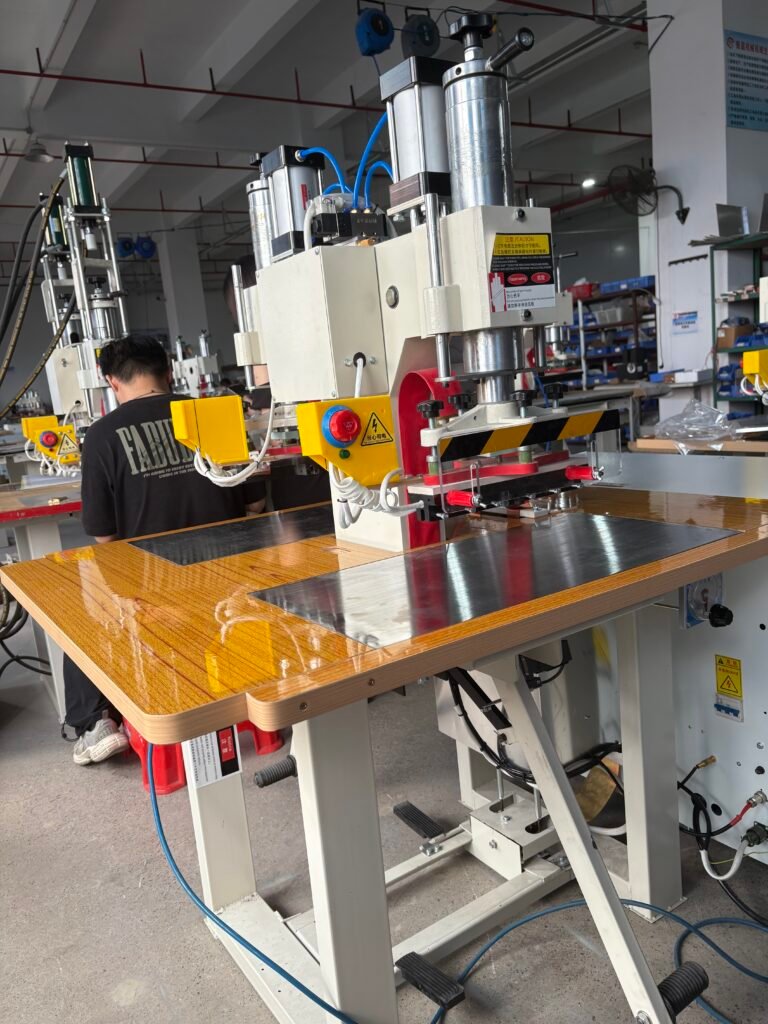
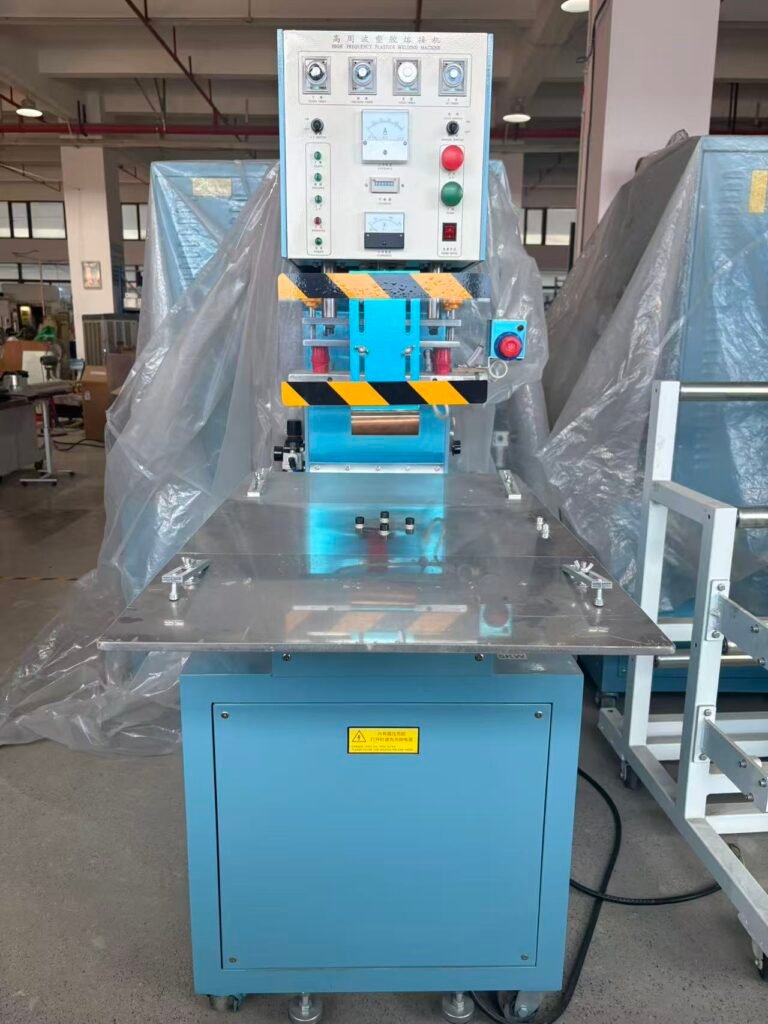
8KW High Frequency Welder for PVC/TPU Products
8KW high frequency welder with PLC touch screen, CE & ISO9001 certified. Ideal for PVC/TPU product manufacturing in Southeast Asia. Durable rotary table design for consistent output.
Step-by-Step Power Calculation for Any Product
Follow this sequence to determine choosing HF welder output power for a specific product.
First, calculate the total seal area. Measure every weld line on the finished part. A simple rectangular seal has four sides. A medical bag with ports, hanger holes, and divider seals may have a dozen separate weld segments. Add them all together. Multiply the total length by the weld width to get the total seal area.
Second, identify the material type and thickness. Measure the total stack thickness at the seal area. If two layers of 0.4-millimeter PVC film are welded, the stack thickness is 0.8 millimeters. If a rigid port flange sits between the layers, include that added thickness at the port location.
Third, multiply the seal area by the power factor for the material and thickness. A 2,000-square-millimeter PVC seal with a 1.0-millimeter stack requires approximately 2.0 to 3.0 kilowatts of delivered RF power. Add a 20% margin for process variation, generator efficiency, and tuning losses. The recommended generator rating for this application is approximately 3.5 to 4.0 kilowatts.
Fourth, verify that the press tonnage can deliver adequate pressure across the entire seal area. Power selection and pressure selection are linked. Insufficient pressure prevents the molten material from consolidating, regardless of how much power is applied.
Common Power Ratings and Their Application Ranges
HF welding machine wattage guide information organizes into distinct power bands. Each band suits a predictable range of products and production volumes.
3kW to 5kW: Small Parts and Thin Films
Machines in this range handle small-area seals on thin materials. Small ID card sleeves, single-pocket file folders, lightweight medical pouches, and cosmetic packaging all weld well at 3kW to 5kW. The typical seal area stays below 2,000 square millimeters per cycle for PVC. These machines suit prototype development, low-volume production, and applications where cycle time is not the primary constraint.
A 5kW high frequency welding machine is often the entry point for manufacturers new to the technology. It handles a useful range of sample work without the capital cost of a larger installation. It also serves as a dedicated machine for a single small product line in a larger factory.
8kW: The Versatile Mid-Range Workhorse
The 8kW power band covers a large fraction of all HF welding applications. It welds standard stationery products, medium-sized medical bags, inflatable product seams, and automotive interior components. The typical seal area ranges from 2,000 to 6,000 square millimeters per cycle in PVC. With appropriate cycle time, it handles multi-cavity tooling for small parts.
Many contract manufacturers choose an 8kW machine as their first unit because it balances capability and cost. It runs a wide enough range of jobs to stay busy. It does not demand the electrical infrastructure of a 15kW or larger machine.
12kW to 15kW: High-Volume and Thick Materials
Machines at 12kW to 15kW suit production environments where cycle time matters and where material stacks are thick. Multi-cavity tooling for stationery products, large-format medical bags, inflatable boat seams, and tarpaulin welding all operate in this range.
A 15kW machine can deliver a complete weld on a 6,000-square-millimeter seal in under 3 seconds. The same seal on an 8kW machine might require 5 to 6 seconds. Over thousands of cycles per day, the time difference translates directly into higher output or an extra shift avoided.
Thick material assemblies benefit from the higher power. Welding 2-millimeter reinforced PVC for an inflatable boat tube demands power that a smaller machine cannot sustain. The 12kW to 15kW range delivers the energy density required for full-thickness fusion.
25kW to 40kW and Above: Heavy Industrial Applications
Large-format and high-power applications move into the 25kW to 40kW range and beyond. Very large medical bag arrays, industrial curtain welding, heavy tarpaulin fabrication, and multi-cavity automotive tooling with seal areas exceeding 15,000 square millimeters per cycle require this power level.
Machines in this class run on dedicated electrical supplies. The installation requires careful planning of the electrical infrastructure, cooling water capacity, and floor loading. The productivity gain from processing large parts in a single cycle justifies the infrastructure investment for high-volume manufacturers.
Special Factors That Shift Power Requirements
Several application-specific factors modify the basic power calculation. Considering these factors before ordering a machine prevents unpleasant surprises during commissioning.
Multi-cavity tooling multiplies the power demand by the number of cavities. A 4-cavity die making medical pouches with 1,500 square millimeters of seal area per cavity demands 6,000 square millimeters total. Size the generator for the total, not for a single cavity.
Materials containing metal components alter the RF field distribution. A medical bag with an aluminum foil layer or a product with embedded metal stiffeners absorbs energy differently from all-plastic assemblies. The metal reflects RF energy and can create hot spots or prevent adequate heating in adjacent areas. Consult the machine manufacturer before welding any material containing metal.
Products with widely varying seal thickness within a single cycle demand higher power to ensure the thickest section reaches temperature. The thin sections require buffer materials to prevent overheating while the thick sections catch up. The power calculation must satisfy the thickest segment.
Continuous operation at high duty cycle requires a generator rated for the sustained thermal load. A machine rated for 15kW at 50% duty cycle may only sustain 12kW at 80% duty cycle. Match the duty cycle rating to the actual production pattern, not just the peak power number.
Avoiding the Two Most Common Power Selection Mistakes
The first mistake selects power based on the largest product the company ever expects to run. A manufacturer chooses a 25kW machine because one customer inquired about a large product. The inquiry does not turn into an order. The machine now runs small parts at 20% of its rated power for years, operating inefficiently and occupying floor space a smaller machine could use.
The second mistake selects power based on current production without considering growth. A manufacturer buys a 5kW machine that perfectly matches today’s volumes. The business grows. The machine becomes the bottleneck. A second 5kW machine is purchased, then a third. Three small machines occupy the floor space and electrical capacity of one 15kW machine, with higher combined maintenance and three times the operator stations.
Split the difference wisely. Size the machine for the products you run today and the products you realistically expect to run in the next two to three years. A small margin for growth prevents early obsolescence. A large margin for speculative growth wastes capital.
Power Selection as a Business Decision
High frequency welding machine power selection is a business decision as much as a technical one. The right power level enables production targets, controls operating costs, and provides flexibility for new products. The wrong power level creates a permanent inefficiency that no parameter adjustment can fix.
Calculate the seal area carefully. Apply the material and thickness factors. Consider the duty cycle and the multi-cavity plans. Select the standard power rating that meets the calculated need with a modest growth margin.
The correctly sized HF welder delivers full-strength welds at the designed cycle rate from the day of installation. It draws only the electrical power it needs. It matches the production flow of the surrounding equipment. That is the definition of a good investment.