 TEL +86-13923172919
HF Welding Power Selection: Choosing 5kW to 25kW by Material and Weld Area
A packaging manufacturer setting up a line for thick PVC tool pouches or a marine gear factory sealing multi-layer TPU inflatable chambers often faces the same purchasing dilemma: choosing between a 5kW, 8kW, 15kW, or 25kW high frequency welding machine. Buying an underpowered press forces operators to extend welding timers, overheating the brass electrode and scorching surface film. Buying an oversized 25kW machine for small blister packs wastes capital, consumes unnecessary floor space, and requires heavier electrical infrastructure than the factory needs.
Effective HF welding power selection is not a guess based on general industry rules. In industrial production, required HF welder wattage is determined by four physical variables: material dielectric response, total material thickness, total weld seam area, and target cycle speed.
Why Higher kW Does Not Automatically Mean Higher Production Output
Before looking at wattage tables, buyers must separate generator power from hourly production capacity. A 15kW high frequency welding machine does not automatically produce three times as many parts per hour as a 5kW unit.
Total production output depends on the complete cycle:
- Operator Loading & Alignment Time: Positioning multi-layer sheets, valves, or blister cards onto the lower platen.
- High-Frequency Heating Time: Typically 2 to 6 seconds when matched properly to weld area.
- Cooling Hold Under Pressure: Holding the clamp closed so molten thermoplastic solidifies without elastic spring-back.
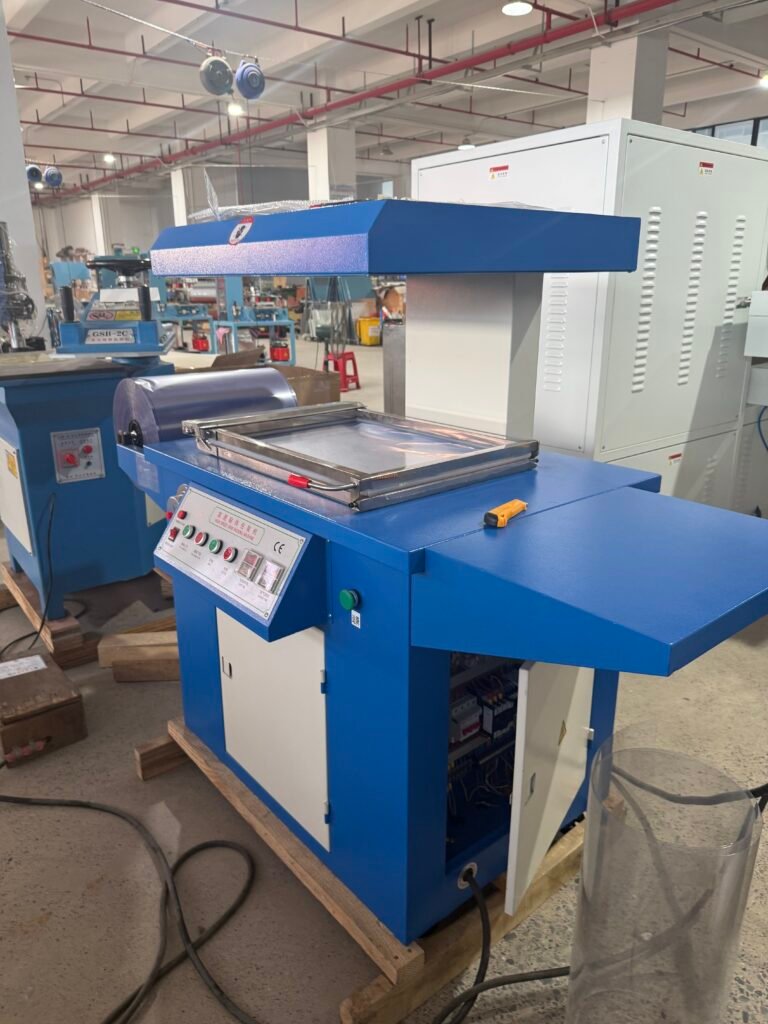
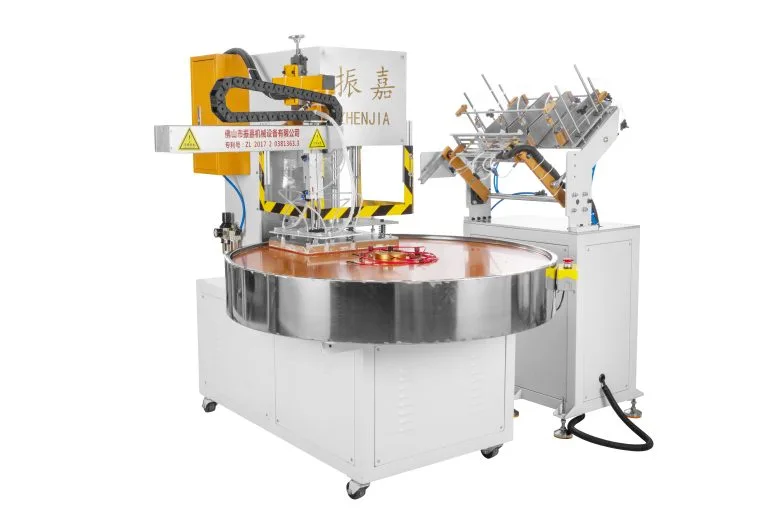
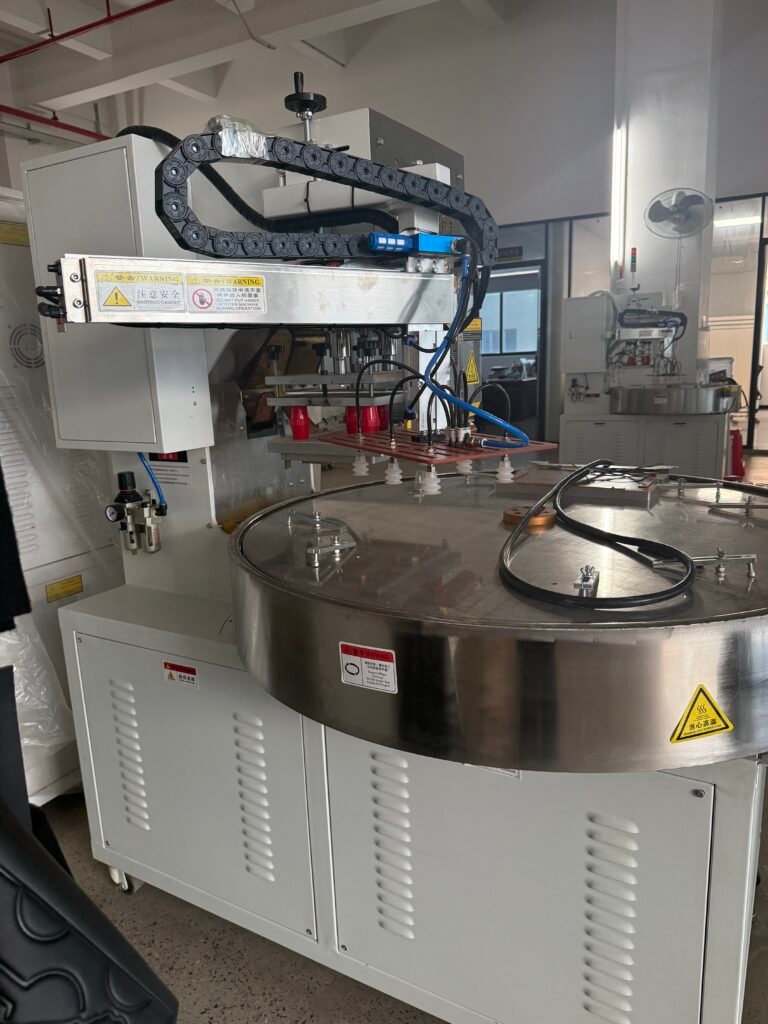
- Machine Configuration: Whether the press uses a single manual tray, a double-head push-plate, or an automatic rotary table.
Generator power determines how large an area and how thick a material stack you can weld cleanly within a short, repeatable heating window (usually under 5 seconds) without exceeding the safe operating load of the oscillator.
Four Core Factors in RF Welding Power Calculation
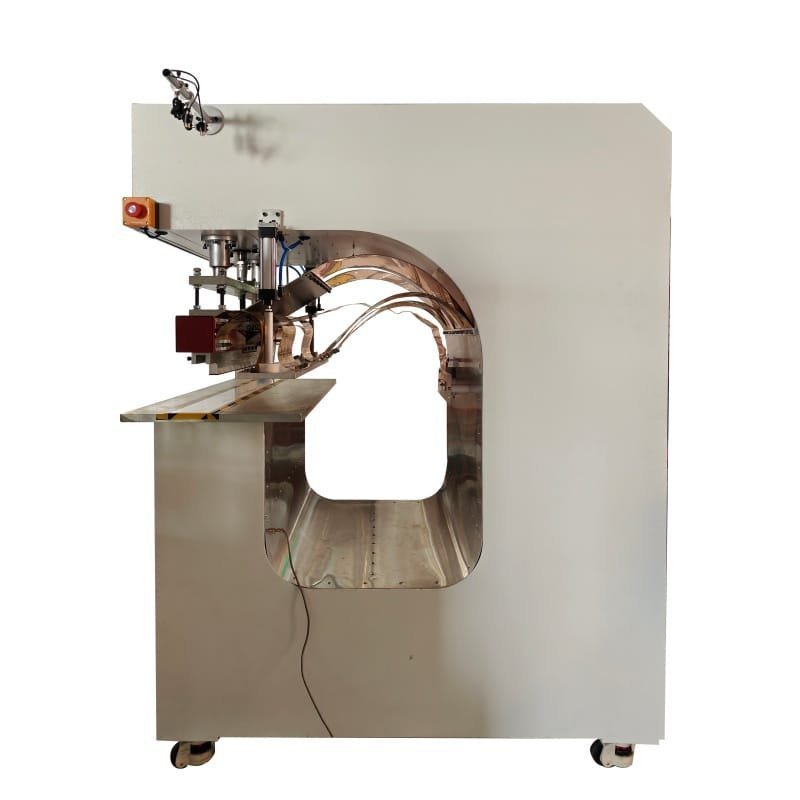
When calculating the required output power for a new PVC welding machine or TPU welding machine, evaluate your product specifications against these four parameters:
1. Material Dielectric Loss Factor
Different thermoplastics absorb 27.12 MHz electromagnetic energy at different rates:
- Plasticized PVC: High dielectric loss factor; heats rapidly and requires lower power density per square centimeter.
- TPU (Thermoplastic Polyurethane) & PU-Coated Fabrics: Moderate-to-high dielectric response, though higher melting points and varying polyester/polyether formulations typically demand slightly more energy than standard soft PVC.
- EVA & PETG: Lower dielectric loss than soft PVC; often requires higher power density, preheated electrodes, or buffer sheets to initiate consistent molecular heating.
2. Total Weld Seam Area (Not Overall Product Size)
RF energy concentrates strictly under the contact surface of the high frequency welding mold. A 1.5-meter-long inflatable kayak chamber might only have a 10 mm wide perimeter weld seam. Always calculate the actual contact area of the brass electrode face (length × width in $\text{cm}^2$ or $\text{in}^2$), rather than the outer dimensions of the finished product.
3. Total Material Stack Thickness
Welding two layers of 0.3 mm PVC film requires far less energy than joining two layers of 1.2 mm reinforced TPU fabric plus a molded injection flange. Thicker cross-sections have greater thermal mass and dissipate heat into the metal platens faster, requiring higher kW output to bring the inner interface to melting temperature before the outer surfaces overheat.
4. Target Cycle Time and Duty Cycle
Running an 8kW generator at 95% maximum anode current on every cycle accelerates component wear and increases arcing risk. Industrial best practice is sizing the generator so your normal production weld runs at 65% to 80% of rated output, leaving headroom for voltage fluctuations or thicker material batches.
Practical Power Selection Guide: 5kW to 25kW by Application
Use the matrix below as an actionable starting point for RF welding power calculation across standard industrial machine ratings. (Note: Exact weldable area varies based on material formulation, electrode geometry, and whether simultaneous tear-sealing is included.)
| Rated Power | Typical Machine Configuration | Material & Thickness Fit | Actionable Production Applications |
| 5kW | Pneumatic C-frame, single-head or double-head foot/pneumatic press | Thin-to-medium PVC, TPU, EVA, or PETG (approx. 0.15 mm – 0.8 mm total stack) | Stationery folders, medical drainage bags, small TPU pouches, footwear logos, small blister packaging |
| 8kW | Pneumatic or hydraulic push-plate, double-head, or 3–4 station rotary table | Medium-gauge PVC, TPU, and coated fabrics (approx. 0.5 mm – 1.5 mm total stack) | Inflatable toys, life vest chambers, automotive sun visors, medium blister packs, waterproof dry bags |
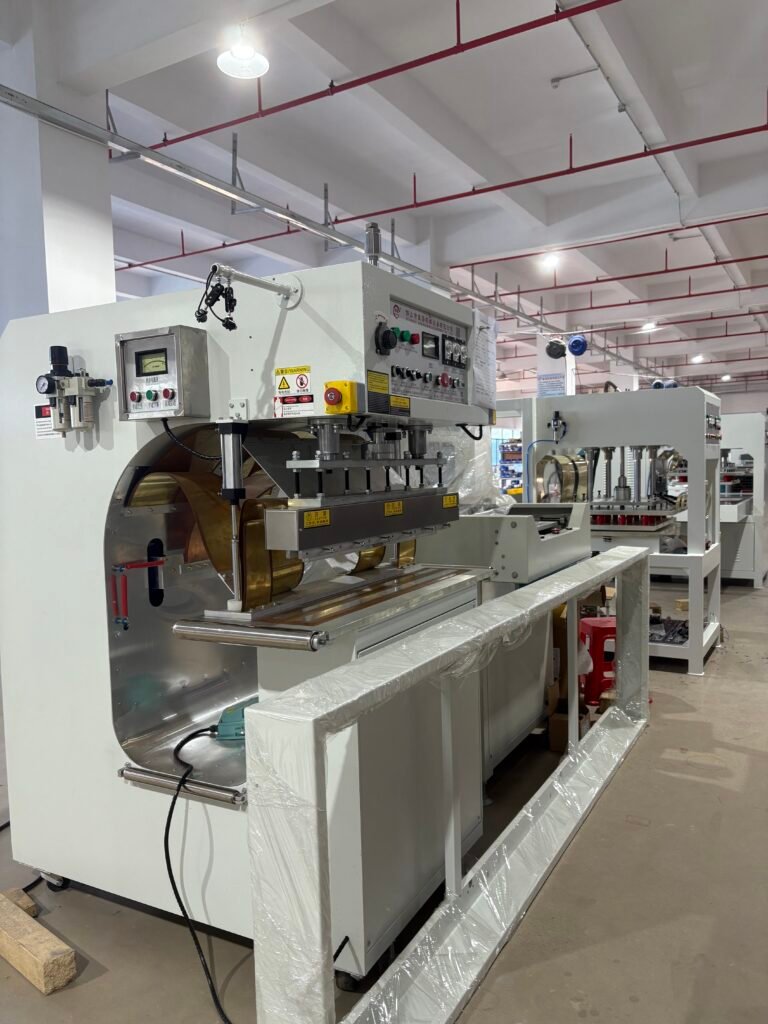
| 12kW – 15kW | Heavy-duty hydraulic press, wide push-plate, or large automatic rotary table | Heavy reinforced PVC/TPU tarpaulins, multi-layer coated fabrics (1.0 mm – 2.5 mm+) | Inflatable boat seams, air mattresses, medium tarpaulin patches, automotive door panels, thick fluid bladders |
| 25kW+ | High-power hydraulic gantry or deep-throat industrial press | Extra-thick multi-layer industrial fabrics, wide perimeter dies, structural membranes | Large architectural membranes, truck side curtains, heavy oil booms, wide-format industrial liners |
Choosing Between Adjacent Power Ratings (e.g., 5kW vs. 8kW or 8kW vs. 15kW)
When your calculated weld area sits near the upper boundary of a power tier, consider these three floor-level factors before finalizing your purchase order:
- Multi-Cavity Tooling Expansion: If you currently weld one medical pouch per cycle on a 5kW machine, upgrading to an 8kW or 15kW HF welder allows you to run a 2-cavity or 4-cavity mold, doubling output per press stroke without adding another operator.
- Tear-Seal (Cut-and-Weld) Dies: If your brass mold incorporates a sharp cutting edge alongside the sealing bar to trim excess PVC or blister flange in the same stroke, the concentrated pressure and metal-to-buffer proximity require extra power reserve and ultra-fast electronic arc suppression.
- Factory Electrical Capacity: Moving from an 8kW press to a 15kW or 25kW unit increases three-phase input current draw. Always confirm your plant’s main breaker rating, wire gauge, and voltage stability (e.g., 380V / 3-Phase / 50Hz or local supply specifications) before ordering high-power equipment.
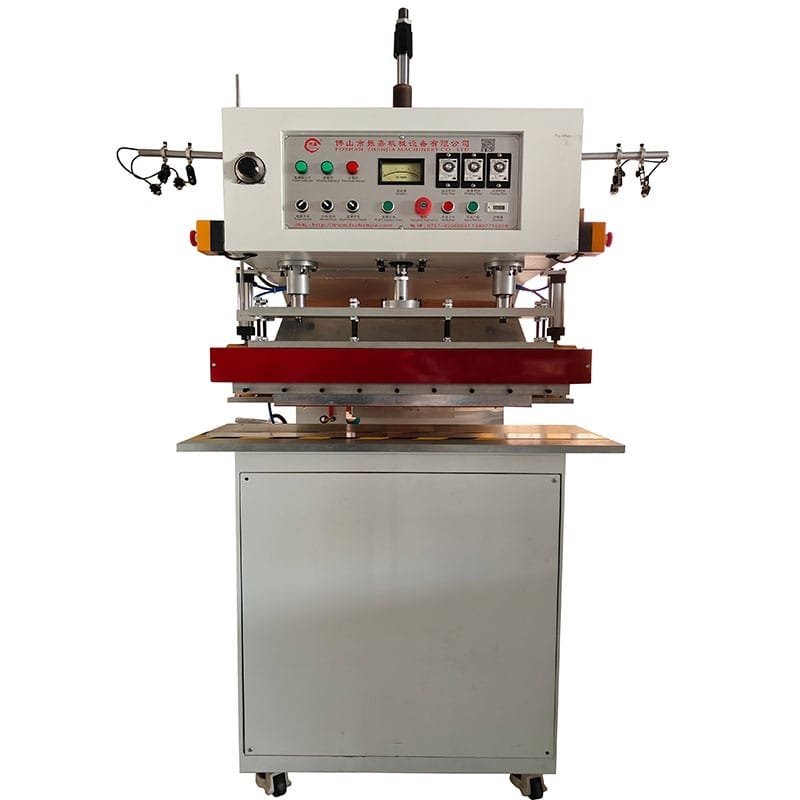
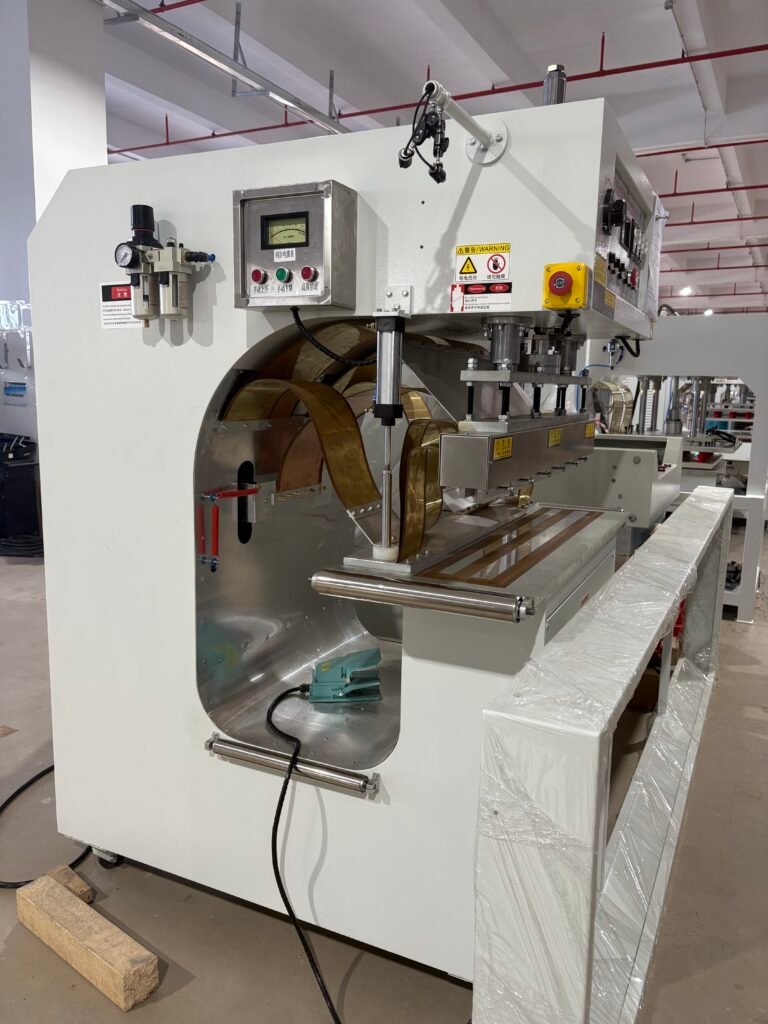
10KW High Frequency Welder for PVC Tarpaulin
The 10KW High Frequency Welder by Zhenjia Machine is a heavy-duty industrial system engineered for the high-strength bonding of PVC, PU, and TPU textiles. Utilizing advanced electronic oscillation with premium Austrian filaments, this HF welder ensures airtight, structurally superior seams for tarpaulins, tents, and architectural membranes. Specifically configured for Southeast Asian manufacturing environments, it provides stable energy output and uniform heat distribution for high-volume production lines requiring durable, weather-resistant, and aesthetic finishes.
Mandatory Safety and Operating Boundaries for High-Power Presses
Higher kW ratings introduce higher RF field intensity and heavier mechanical clamping forces. Strict operational boundaries must be enforced regardless of machine size:
- MUST verify factory grounding and dedicated earth lines before commissioning any 5kW to 25kW RF welding machine. Inadequate grounding causes stray RF interference and increases shock hazards.
- MUST match hydraulic or pneumatic clamping force to the electrode surface area. High RF power applied under insufficient mechanical pressure causes air gaps, dielectric arcing, and immediate damage to custom brass dies.
- PROHIBITED: Never run a high-power generator at maximum output to compensate for an uncalibrated or poorly leveled mold. Uneven platen parallelism concentrates RF current on one edge, burning the material and pitting the electrode.
- PROHIBITED: Never operate the press with safety shielding doors open, interlocks bypassed, or hands inside the work zone during table shuttle or platen descent.
- NEVER finalize a high-power equipment order for new TPU blends, flame-retardant coatings, or multi-layer composites without sample proofing on the target kW rating to verify weld peel strength and airtightness.