 TEL +86-13923172919
Ultrasonic Welding Machine: How It Works, Types, and What to Look For in 2025
An ultrasonic welding machine bonds materials in seconds — without glue, screws, or external heat. It uses high-frequency sound waves to generate precise friction at the joint interface, fusing parts together cleanly and permanently. Industries from automotive to medical rely on this technology daily. This guide covers how it works, which machine type suits which application, and what to look for before you buy.
What Is an Ultrasonic Welding Machine?
An ultrasonic welding machine uses high-frequency mechanical vibrations — typically between 20 kHz and 40 kHz — to join two materials under pressure. The vibrations create localized frictional heat at the contact surface. That heat melts the material. Pressure then fuses the softened layers together. When the vibration stops, the joint solidifies in place.
The process happens in milliseconds to seconds. It requires no adhesives, no solvents, and no consumables. The weld is clean, strong, and repeatable — making the ultrasonic welding machine one of the most efficient joining technologies available today.
Most ultrasonic welding machines work with thermoplastics. Common compatible materials include ABS, polypropylene (PP), polyethylene (PE), polycarbonate (PC), nylon, PVC, and acrylic. Specialized machines also weld metals — particularly copper and aluminum — for applications in electronics and battery manufacturing.
How Does an Ultrasonic Welding Machine Work?
The machine converts electrical energy into mechanical vibration through a precise sequence of components. Understanding each part helps operators set up and maintain the system correctly.
The ultrasonic generator. The generator converts standard mains power into a high-frequency electrical signal — typically at 20 kHz or 35 kHz. It controls the amplitude and energy delivered to the transducer. Modern generators use digital processors to monitor and adjust output in real time.
The transducer (converter). The transducer converts the high-frequency electrical signal into mechanical vibration. It uses piezoelectric ceramic elements that expand and contract in response to the alternating electrical current. The result is a longitudinal vibration that travels through the stack.
The booster. The booster amplifies the vibration amplitude from the transducer. It also provides the mounting point that isolates the vibrating assembly from the press frame. Boosters come in different ratios — 1:1, 1:1.5, 1:2 — to increase or reduce amplitude as the application requires.
The sonotrode (horn). The sonotrode is the tool that makes direct contact with the workpiece. It transmits the mechanical vibration to the material surface. Sonotrode design is critical — its shape must match the weld geometry and resonate correctly at the operating frequency. A poorly designed sonotrode causes uneven welds and premature fatigue.
The press and fixture. A pneumatic or servo-driven press brings the sonotrode down onto the part with controlled force. A nest or fixture holds the lower part in precise alignment. Good fixture design distributes pressure evenly and prevents part movement during welding.
When these components work together in calibration, the ultrasonic welding machine delivers consistent, repeatable joints with very short cycle times — often under one second for thin-wall parts.
Types of Ultrasonic Welding Machines
Manufacturers offer several configurations. Each suits different production volumes, part sizes, and levels of automation.
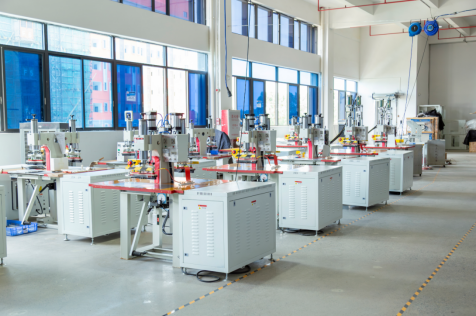
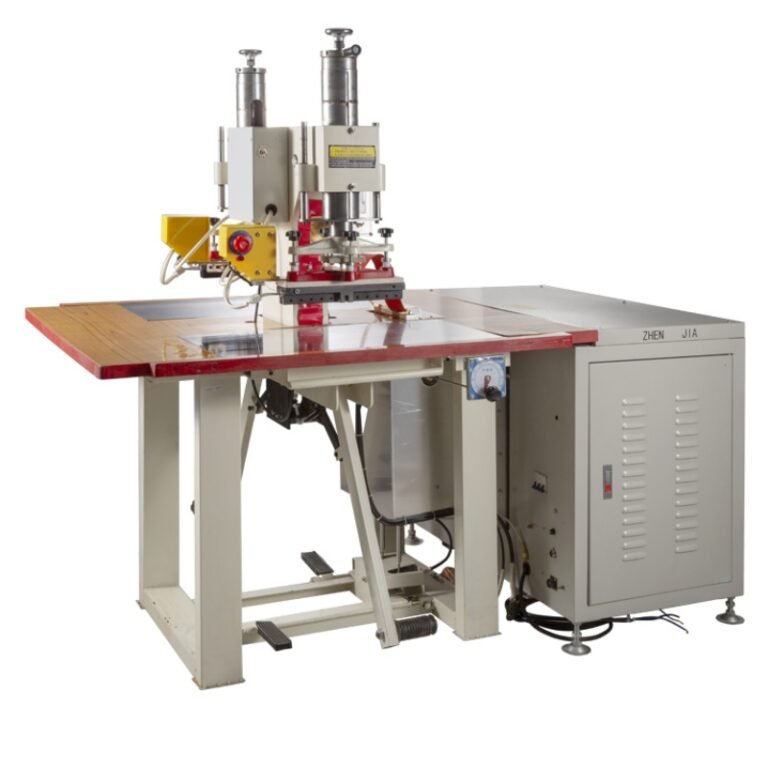
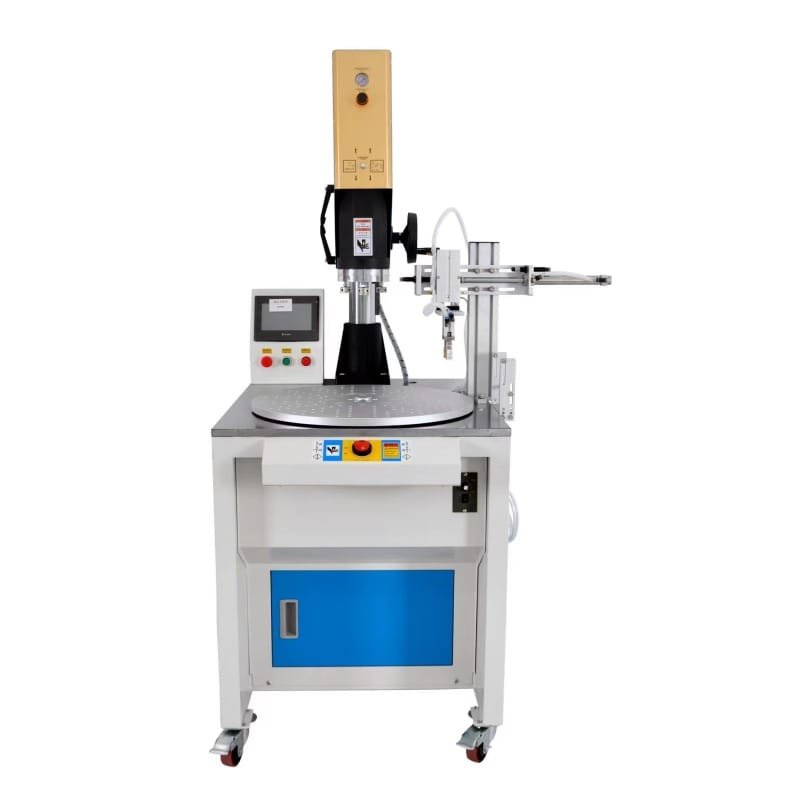
Benchtop ultrasonic welding machine. The most common configuration in small and mid-scale production. The machine sits on a workbench and the operator feeds parts manually. Benchtop models suit prototyping, short production runs, and applications that require frequent tooling changes. They offer good control flexibility at a moderate price point.
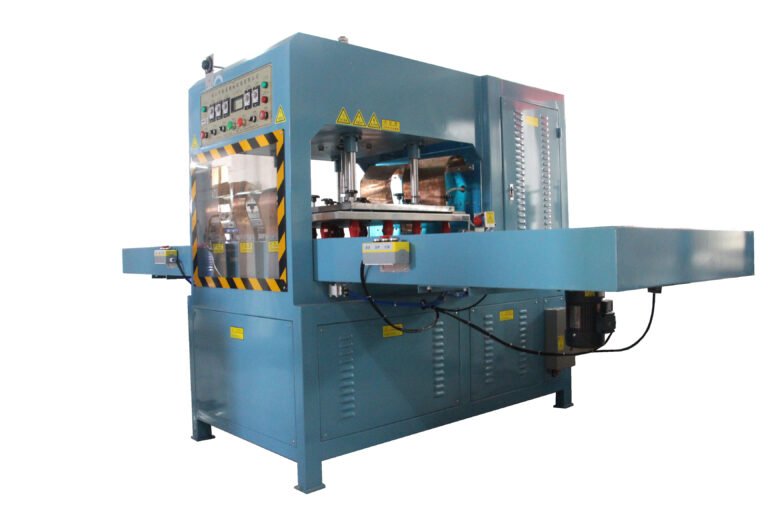
Automatic ultrasonic welding machine. An integrated system where feeding, welding, and ejection happen automatically. The automatic ultrasonic welding machine suits high-volume lines where throughput and consistency are the priority. It reduces operator involvement and eliminates cycle-to-cycle variation caused by manual handling. Integration with conveyors, robotic arms, and vision inspection systems is standard.
Handheld ultrasonic welder. A portable unit that the operator holds and directs manually. Handheld ultrasonic welders suit large or irregular parts that cannot move under a fixed press — such as automotive panels or outdoor equipment housings. They offer flexibility at the cost of precision and repeatability.
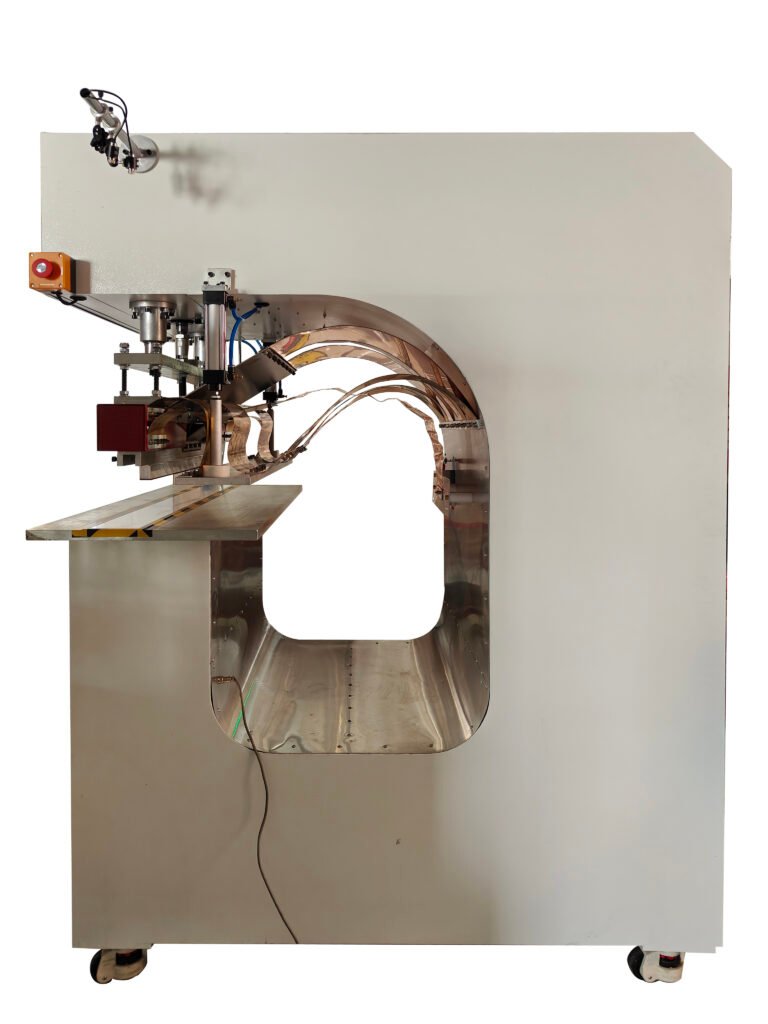
Ultrasonic seam welder. A rotary version of the technology. A spinning wheel sonotrode travels continuously along a seam, producing a long, unbroken weld line. Ultrasonic seam welders are widely used in packaging, textiles, and nonwoven fabric bonding — applications that require continuous joins rather than spot welds.
Ultrasonic spot welder. Produces a localized spot weld without the need for a through-hole or energy director. Spot welders suit fabric, film, and nonwoven material applications. They are also used in automotive interior assembly to tack fabric to substrates before final bonding.
Ultrasonic metal welding machine. A specialized configuration designed for joining conductive metals — primarily copper and aluminum. Ultrasonic metal welders produce solid-state bonds without melting the base material. They are essential in battery pack assembly, wire harness termination, and electronics manufacturing, where thermal damage to components must be avoided.
Industries and Applications
The ultrasonic welding machine serves a wide range of industries. Each sector values different aspects of the technology — speed, cleanliness, precision, or material flexibility.
Automotive. The automotive industry is one of the largest users of ultrasonic plastic welding machines. Door panels, instrument clusters, light assemblies, fluid reservoirs, and interior trim pieces all rely on ultrasonic welds. The shift toward electric vehicles increases demand further — EV platforms use more lightweight plastics than conventional vehicles, and ultrasonic welding handles these materials efficiently.
Medical devices. Medical applications demand sterile, contamination-free bonds. Ultrasonic welding produces clean joints without adhesives or solvents, which means no chemical residue and no secondary curing steps. Blood filters, IV connectors, surgical instrument housings, and diagnostic device enclosures all use this process. The repeatable nature of servo-driven ultrasonic welding also supports the process validation requirements common in regulated medical manufacturing environments.
Electronics and batteries. Ultrasonic metal welding machines play a critical role in battery manufacturing. They join copper and aluminum foil tabs in lithium-ion cells, connect wire terminals to busbars, and bond cell connectors — all without generating enough heat to damage sensitive cell chemistry. The process produces low-resistance joints with minimal heat-affected zones, both of which are essential for battery performance and longevity.
Packaging. Ultrasonic welding seals blister packs, food packaging, medical pouches, and retail display packaging at high speed. The clean seal it produces meets both visual and functional requirements — important for consumer-facing packaging where appearance matters as much as integrity.
Textiles and nonwovens. Ultrasonic seam welders bond nonwoven fabrics used in hygiene products, protective clothing, and filtration media. The process replaces stitching and adhesives, producing softer seams with better strength and no needle holes — an important quality for fluid-resistant applications like surgical gowns and diapers.
Toys and consumer goods. Toy assembly relies heavily on ultrasonic welding for joining plastic housings quickly and safely. The process eliminates solvents and fasteners, making the finished product safer for children and easier to assemble at scale.
Ultrasonic Welding vs. Other Plastic Joining Methods
vs. High frequency (RF) welding. HF welding uses electromagnetic energy to generate heat inside polar thermoplastics. It works well on flexible PVC and PU films — materials that ultrasonic welding handles less efficiently. Ultrasonic welding handles rigid thermoplastics like ABS and PP far better than HF welding. Many manufacturers use both technologies in the same facility, each for the materials it suits best.
vs. Hot plate welding. Hot plate welding uses a heated platen to melt material surfaces before pressing them together. It suits large, flat joints and thick-walled parts. But the cycle is slow — typically 30 to 60 seconds — and the hot plate contacts the part directly, risking surface contamination. Ultrasonic welding is significantly faster and produces no direct contact between a heat source and the material.
vs. Adhesive bonding. Adhesives join almost any material combination but require mixing, application time, cure time, and ventilation. They also add weight and can fail under heat or chemical exposure. Ultrasonic welding eliminates all of these variables. It produces immediate structural bonds with no consumables and no cure cycle.
vs. Laser welding. Laser plastic welding produces very fine, aesthetically clean joints ideal for transparent or precision medical components. It is slower than ultrasonic welding and requires one material to be laser-transparent and the other laser-absorbing. Ultrasonic welding imposes no such optical constraints and runs faster for most standard part geometries.
Key Features to Look for When Buying an Ultrasonic Welding Machine
Digital generator with closed-loop control. A digital generator monitors amplitude, energy, force, and time throughout every weld cycle. Closed-loop control adjusts output in real time to compensate for part variation. This improves weld consistency and reduces reject rates — especially important in high-volume or quality-critical applications.
Operating frequency. Lower frequencies (15–20 kHz) deliver higher amplitude and more power — suited to large parts and rigid, hard-to-weld materials. Higher frequencies (30–40 kHz) deliver finer vibration and less mechanical stress — suited to small, delicate parts and thin-wall assemblies. Choose the frequency that matches your part geometry and material.
Servo-driven press. A servo press replaces the traditional pneumatic cylinder with a motor-driven actuator. It provides programmable speed and force profiles throughout the stroke — not just at the point of contact. Servo presses improve joint quality on sensitive or geometrically complex parts and enable far more precise process data logging.
Weld mode selection. Modern ultrasonic welding machines offer multiple weld modes: time mode, energy mode, peak power mode, and distance mode. Energy mode is generally the most consistent for production welding — it delivers a fixed amount of energy per cycle regardless of part variation. Distance mode suits applications where final part height must remain consistent.
Data logging and Industry 4.0 connectivity. Industrial buyers increasingly require machines that log process data — energy, time, force, distance, and amplitude — for every weld. This data supports quality traceability, process optimization, and predictive maintenance. Look for machines with Ethernet, OPC-UA, or Profibus connectivity if you plan to integrate into a wider production network.
Tooling quality and interchangeability. The sonotrode is the most application-specific component in the system. Confirm that the machine manufacturer supports custom sonotrode design for your part geometry. Also check whether the booster and sonotrode mount follows a standard interface — this makes it easier to source tooling from third-party suppliers and reduces your dependence on a single vendor.
How to Choose the Right Ultrasonic Welding Machine
Start with your material. Confirm that your plastic or metal is compatible with ultrasonic welding. Rigid thermoplastics weld best. Semi-crystalline materials like PP and PE require careful joint design. Soft or foam-based materials absorb vibration and produce weak welds. Metal welding requires a machine specifically configured for that purpose.
Define your joint geometry. The shape of the weld area determines sonotrode design and machine configuration. Flat, simple joints suit standard benchtop machines. Complex three-dimensional joints require custom sonotrode profiling and may need a servo press for precise stroke control.
Match output power to part size. Larger parts and harder materials require more power. Most benchtop machines offer 500 W to 3,000 W. Automated industrial systems go higher. Undersized generators produce incomplete welds. Oversized ones risk part deformation. Ask your supplier to calculate the recommended power level based on your specific weld area.
Consider production volume. Manual benchtop machines suit low to medium volumes. Automatic ultrasonic welding machines with integrated handling suit high-volume continuous production. Handheld units suit field use or large part assemblies where the machine cannot come to the part. Match the machine format to your actual production rate.
Plan for process validation. If you produce medical devices or regulated products, ensure the machine supports IQ/OQ/PQ validation. This means full data logging, password-controlled parameter access, audit trail functionality, and documented process repeatability testing. Not all machines support this out of the box.
Frequently Asked Questions
What is an ultrasonic welding machine used for?
It joins thermoplastic parts and conductive metals without adhesives or external heat. Common applications include automotive interior assembly, medical device manufacturing, electronic component joining, packaging sealing, and battery tab welding.
What frequency does an ultrasonic welding machine operate at?
Most plastic welding machines operate at 20 kHz or 35–40 kHz. Lower frequencies suit larger, harder parts. Higher frequencies suit small, delicate, or thin-wall parts. Ultrasonic metal welders typically operate at 20 kHz or 40 kHz depending on the joint size and material thickness.
What plastics can an ultrasonic welding machine weld?
It works well with ABS, polycarbonate, acrylic, nylon, PVC, polystyrene, and many engineering thermoplastics. Semi-crystalline materials like polypropylene and polyethylene weld but require careful joint design. Soft or elastomeric materials generally do not weld well ultrasonically.
How long does an ultrasonic weld cycle take?
Weld time ranges from under one second for thin-wall parts to several seconds for thicker or harder materials. A complete cycle — including press movement, weld, hold, and release — typically runs between one and five seconds. This makes ultrasonic welding one of the fastest plastic joining methods available.
What is the difference between a 20 kHz and a 35 kHz ultrasonic welder?
A 20 kHz machine delivers higher amplitude and more raw power — suited to large weld areas, thick parts, and hard-to-weld materials. A 35 kHz machine delivers finer, lower-amplitude vibration — suited to small, delicate parts where lower mechanical stress reduces the risk of cracking or surface marking.
Can an ultrasonic welding machine weld metal?
Yes, with a machine specifically configured for metal welding. Ultrasonic metal welders join copper and aluminum without melting the base material. They are widely used in battery tab welding, wire harness termination, and connector assembly in electronics and EV manufacturing.
What is the difference between an automatic and a manual ultrasonic welding machine?
A manual machine requires the operator to load parts, trigger the weld cycle, and remove finished parts by hand. An automatic ultrasonic welding machine integrates feeding, welding, and ejection into a continuous automated process. Automatic machines suit high-volume production. Manual machines suit lower volumes, prototyping, and applications where frequent tooling changes are needed.