 TEL +86-13923172919
CE HF Welder Compliance: Understanding RF Welding Machine Certification Under EMC, Low Voltage, and Machinery Directives
A CE certified high frequency welding machine carries more than a sticker. The CE marking declares that the manufacturer has verified the machine against a specific set of European directives. It confirms the machine meets essential health, safety, and environmental protection requirements. For any manufacturer exporting to the European Economic Area, this marking is not optional. It is a legal passport.
Buying a machine without genuine CE compliance exposes the importer to fines, forced product recalls, and total denial of market access. A machine that carries only a fake label may lack the safety guards, the electromagnetic shielding, or the electrical integrity that the directives demand. This guide explains what a CE HF welder certification actually covers, why it governs European exports, and what real compliance means for your production floor.
The Three Pillars of CE Compliance for HF Welding Machines
CE compliance for industrial RF welding equipment is not a single test. It rests on three core European directives that address electromagnetic emissions, electrical safety, and mechanical hazards. Each directive applies fully to every RF welding machine certification process.
The EMC Directive: Controlling Electromagnetic Emissions
The Electromagnetic Compatibility Directive governs how much electromagnetic energy a machine may emit and how well it resists external interference. High frequency welding machines intentionally generate powerful radio frequency fields. These fields can disrupt nearby electronics, radio communications, and factory networks.
A European standard HF welder must meet the emission limits defined in EN 55011 for industrial, scientific, and medical equipment. The machine must not radiate energy above prescribed field strengths at specified distances. It must also demonstrate immunity to external electrical disturbances so that nearby equipment does not cause it to malfunction. Compliance requires testing in an accredited laboratory and a detailed technical report.
The practical benefit of EMC compliance extends beyond legal access. A machine that contains its RF energy also welds more consistently. Stray emissions represent lost power that fails to heat the material. A well-shielded machine directs energy where it belongs.
The Low Voltage Directive: Electrical Safety at Every Operating Point
The Low Voltage Directive protects operators from electric shock, fire, and thermal injury. It applies to equipment operating between 50 and 1,000 volts AC or 75 and 1,500 volts DC. HF welders fall squarely within this range, both on the mains input side and within the high-voltage DC circuits of the generator.
Compliance requires double or reinforced insulation between live parts and accessible surfaces. Earthing and bonding connections must handle fault currents without overheating. Creepage and clearance distances must match the operating voltages. Components such as transformers, contactors, and cabling must carry recognized safety certifications.
A CE marking HF welding machine under the Low Voltage Directive also includes protection against thermal hazards. Surfaces that exceed safe touch temperatures require guards, warning labels, or active cooling. The certification demands a full thermal assessment under maximum rated duty cycle.
The Machinery Directive: Protecting Operators from Mechanical Injury
The Machinery Directive addresses crush hazards, cutting hazards, and the integrity of safety control systems. An HF welding press applies tons of force. Without proper guarding and control, it can crush hands or fingers.
Compliance requires a combination of fixed guards, interlocked movable guards, and safety-rated control circuits. Two-hand controls prevent single-handed operation. Light curtains stop press motion when breached. Emergency stop buttons bring all hazardous movements to an immediate halt. The safety system design must meet Performance Level requirements defined in ISO 13849.
The Machinery Directive also mandates that the machine remains stable during operation and transport. The frame and anchoring must resist the forces of the press cycle without tipping or shifting. Sharp edges, pinch points, and ejection hazards all require elimination or guarding.
Why CE Certification Governs European Exports
The European Economic Area enforces CE marking as a legal requirement. Customs authorities in all EU member states plus Norway, Iceland, and Liechtenstein check for the CE mark and the accompanying Declaration of Conformity before clearing a machine for import. A machine arriving without these documents faces rejection at the port.
The responsibility for compliance falls on the entity placing the machine on the European market. For a machine imported from outside the EU, the importer or the manufacturer’s authorized representative assumes this responsibility. They must hold the full technical file, make it available to authorities upon request, and affix their name to the Declaration of Conformity.
Non-compliance carries severe penalties. Enforcement agencies can force the withdrawal of all non-compliant units from the market. Fines can reach into the hundreds of thousands of euros. In cases of operator injury traced to a non-compliant machine, criminal liability may follow. The RF welding machine certification is therefore a risk management requirement as much as a marketing advantage.
What Buying a Genuine CE-Certified Machine Means in Practice
Purchasing a CE certified high frequency welding machine delivers practical value well beyond the legal right to sell into Europe. The certification process forces the manufacturer to resolve safety and performance issues before the machine reaches your floor.
Certified machines include properly guarded electrodes, preventing the RF burn injuries described in the safety chapter of this series. They contain their electromagnetic emissions, reducing interference with your other factory equipment. Their electrical systems meet international safety standards, lowering the risk of shock or fire. Their control systems perform safety functions with documented reliability.
The certification also forces documentation discipline. A CE-compliant machine arrives with a user manual that accurately describes installation, operation, maintenance, and residual risks. The wiring diagram matches the actual wiring. The component list specifies exact part numbers. This documentation supports your own quality system certifications and makes future maintenance far easier.
Verifying That a Machine Is Genuinely Compliant
Not every machine that carries a CE mark meets the requirements. Some manufacturers affix the mark without performing the required testing. Others test to incorrect standards. Verifying genuine compliance requires looking past the label on the cabinet.
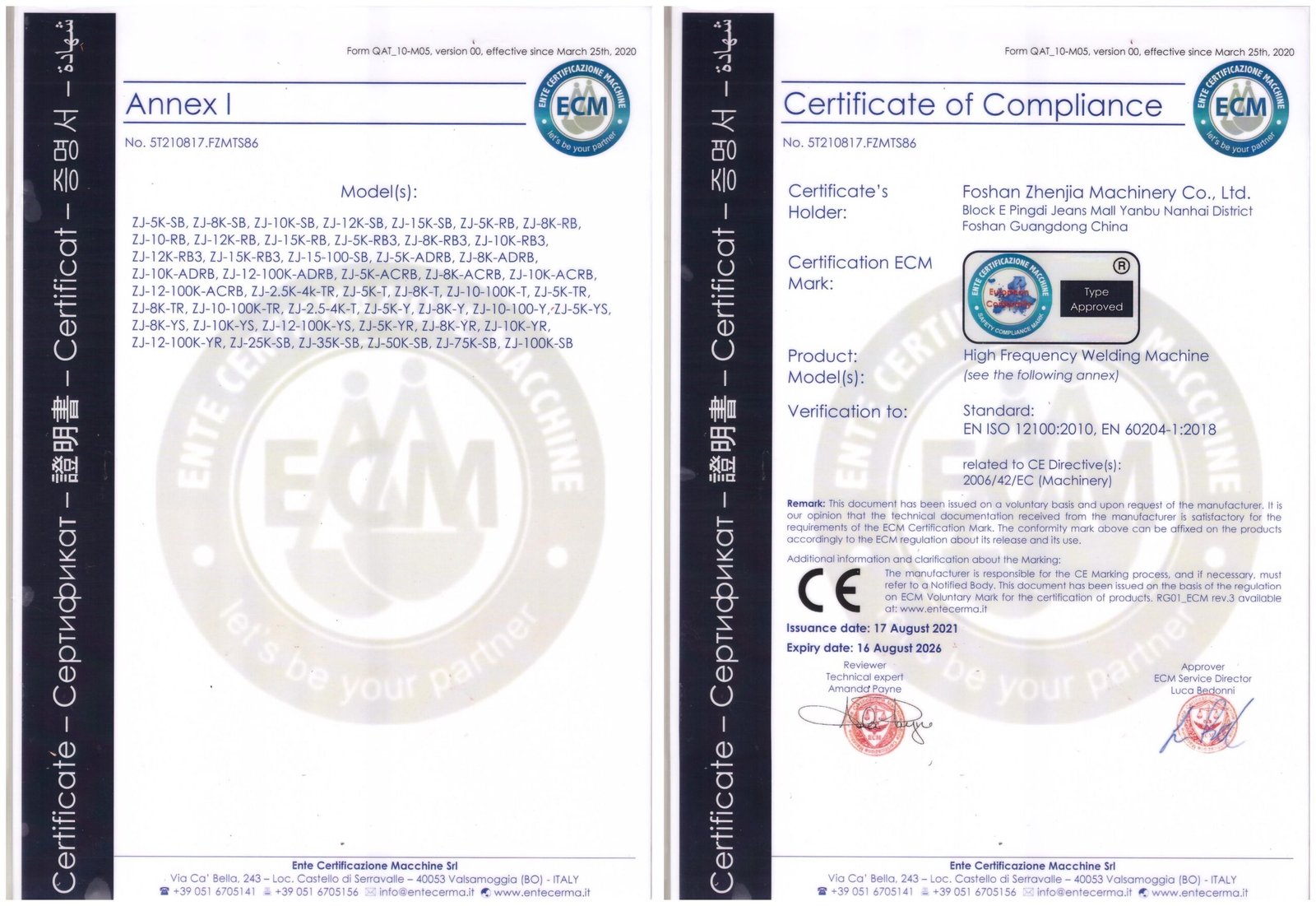
Request the Declaration of Conformity before placing an order. This document must list each directive and harmonized standard the machine meets. It must identify the manufacturer or authorized representative by name and address. It must carry a dated signature of a person with legal authority.
Ask for the technical file summary. The full file remains confidential, but a reputable manufacturer provides a summary that lists the testing laboratories, the test standards, the key test results, and the component certifications. A manufacturer that hesitates to share this information may not have it.
Inspect the machine’s CE label itself. It must include the CE logo of correct proportions. If a notified body was involved, the label includes the notified body number. Most HF welders do not require notified body approval because they fall under self-certification modules. A notified body number on an HF welder without justification may indicate a misunderstanding of the requirements or a deliberate misrepresentation.
The Real Cost of Skipping Certification
A non-certified machine may carry a lower purchase price. The total cost of ownership usually tells a different story. Installing a non-compliant machine in a European facility exposes the importer to legal action. Installing one anywhere in the world introduces avoidable safety risks and reliability problems.
Retrofitting a non-compliant machine to meet CE requirements after purchase is a costly undertaking. The necessary safety circuit redesign, EMC shielding addition, and electrical insulation upgrade often exceed the original price difference. Retrofitting also cannot easily replicate the documentation trail that a certified machine carries from its design phase.
A CE HF welder purchased from a manufacturer committed to European standards integrates compliance into every stage of engineering, assembly, and testing. The cost of that integration is built into the machine price and is almost always lower than the cost of bolting compliance on later.
Certification as a Foundation for Quality
CE certification does not guarantee that a machine will produce perfect welds for a decade. It does guarantee that the machine meets safety, health, and environmental standards recognized across an entire continent. The electromagnetic shielding, the safety guards, the electrical integrity, and the documentation all contribute to a machine that is safe to operate, dependable in production, and legally accepted in the world’s largest single market.
When a CE certified high frequency welding machine arrives on your floor, it arrives with the proof that someone tested it, documented it, and stood behind it. That proof matters to regulators. It matters to insurers. It matters to your operators. And it matters to your customers, who rely on your production to meet their own standards.