 TEL +86-13923172919
The Complete Guide to Automatic High Frequency Welding Machine: Technology, Applications, and Procurement Strategies for 2026
Looking for an automatic high frequency welding machine? This comprehensive guide covers working principles, industry applications, key selection criteria, maintenance best practices, and market trends to help you make an informed investment decision.
Introduction: Why High Frequency Welding Machines Are Essential for Modern Manufacturing
High frequency welding machines (also known as RF welders or dielectric welders) have become indispensable tools in global manufacturing, particularly for processing plastic materials and canvas products. These automatic high frequency welding machines use electromagnetic energy to generate heat within materials, creating strong, clean, and consistent welds that traditional methods cannot achieve .
The global high frequency welding machine market is experiencing steady growth, driven by increasing demand from packaging, automotive, construction, and medical industries. As manufacturing processes become more automated and quality standards rise, the need for precise, efficient, and reliable welding equipment continues to expand .
Whether you’re manufacturing tarpaulins, inflatable structures, automotive interiors, or medical devices, selecting the right automatic high frequency welding machine is critical for production efficiency, product quality, and long-term profitability. This guide provides everything you need to know before making your purchase decision.
1. What Is a High Frequency Welding Machine? Working Principle Explained
1.1 The Science Behind High Frequency Welding
High frequency welding machines operate on the principle of electromagnetic induction or dielectric heating. When an alternating current passes through a coil, it generates a high frequency electromagnetic field (typically operating at 27.12 MHz, the internationally allocated ISM band). When polar materials like PVC or polyurethane are placed within this field, the molecules begin to oscillate rapidly—up to millions of times per second .
This rapid molecular vibration generates internal heat directly within the material, softening the surfaces so they fuse together under applied pressure. Unlike conduction heating methods that transfer heat from the outside in, high frequency welding heats the material from within, resulting in faster cycles and more uniform welds .
1.2 Key Components of an Automatic High Frequency Welding System
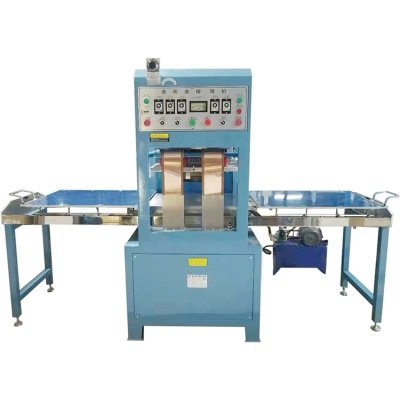
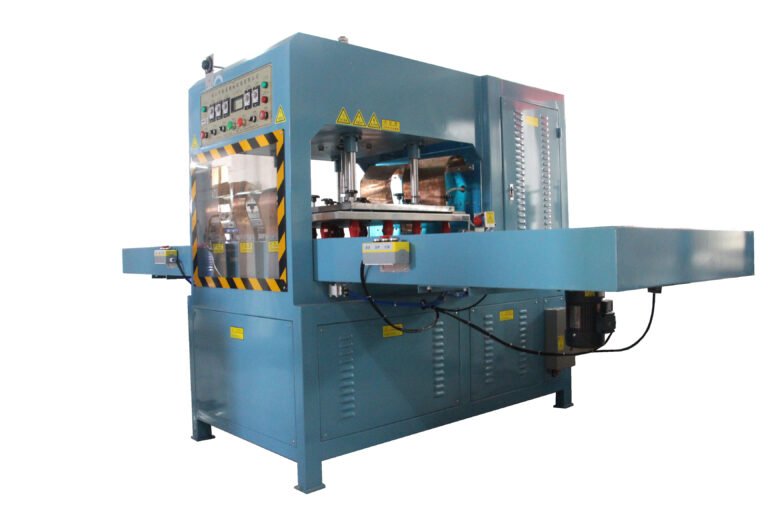
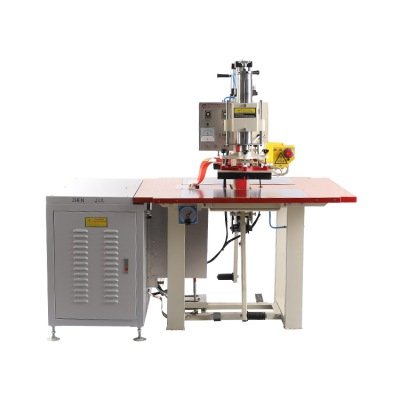
A complete automatic high frequency welding system typically includes:
| Component | Function |
|---|---|
| High Frequency Generator | Produces the electromagnetic field at specified frequency (usually 27.12 MHz) |
| Press/Work Table | Applies controlled pressure during the welding cycle |
| Molds and Electrodes | Shape the weld and conduct energy to the material |
| PLC Control System | Manages welding parameters and automates the cycle |
| Cooling System | Prevents overheating of electronic components |
| Safety Interlocks | Ensures operator protection during operation |
1.3 Types of High Frequency Welding Machines
Based on configuration and application, high frequency welding machines can be categorized into several types :
By Structure:
- Slide Table Machines: Feature dual-station sliding tables that allow loading/unloading during welding, maximizing productivity
- Rotary Table Machines: Multiple stations rotate through the welding zone, ideal for high-volume production
- Manual/Automatic Presses: Simpler designs for basic applications or smaller production runs
By Power Rating:
- Low Power (3-5 kW): Suitable for small parts, medical devices, and light materials
- Medium Power (8-12 kW): Versatile for general industrial applications
- High Power (15-30+ kW): Heavy-duty applications, thick materials, and large welding areas
By Welding Type:
- High Frequency Current Welding: Used primarily for metal tube/pipe welding
- High Frequency Induction Welding: For plastic materials and specialized applications
2. Industry Applications: Where High Frequency Welding Machines Excel
2.1 Plastic Welding Applications
Packaging Industry
High frequency welding technology is used in over 70% of plastic packaging production in developed countries. These machines quickly seal plastic bags, containers, and blister packs. In food packaging, high frequency welded seals can extend product shelf life by up to 30% compared to other sealing methods .
Automotive Industry
A typical mid-size car contains over 50 plastic parts welded using high frequency technology, including dashboards, door panels, seat covers, and interior trim components. The seamless, strong welds enhance both durability and aesthetics .
Medical Devices
Blood bags, IV fluid bags, inflatable splints, and other medical products require absolutely leak-proof seals. High frequency welding provides the consistency and reliability that medical applications demand.
2.2 Canvas and Textile Welding Applications
Outdoor Products
Tents, awnings, and tarpaulins benefit from high frequency welded seams that are completely waterproof. Tents with high frequency welded seams can withstand rainfall of up to 200mm/hour without leakage .
Advertising and Signage
Canvas banners and signs welded with high frequency machines last 2-3 times longer than those joined by traditional stitching, making them ideal for long-term outdoor advertising .
Inflatable Structures
Bouncy castles, inflatable boats, and air dancers require airtight seams that only high frequency welding can reliably produce.
2.3 Metal Welding Applications (High Frequency Induction)
Pipe and Tube Manufacturing
High frequency welding is widely used for producing welded pipes and tubes from carbon steel, stainless steel, and other metals. Production speeds can reach up to 90 meters per minute for smaller diameters .
Radiator and Heat Exchanger Production
The automotive and HVAC industries rely on high frequency welding for manufacturing radiators, condensers, and other heat exchange components.
3. Key Advantages of Automatic High Frequency Welding Machines
3.1 Unmatched Efficiency
Compared to traditional welding methods, high frequency welding machines complete the process in a fraction of the time. In plastic packaging, a high frequency machine can seal up to 500 bags per minute—3-5 times faster than manual or traditional heat-sealing methods .
3.2 Superior Weld Quality
The internally generated heat creates uniform temperature distribution, resulting in strong, consistent welds. For canvas products, high frequency welded seams have tensile strength 20% higher than traditionally sewn seams .
3.3 Energy Savings
High frequency welding can save up to 30% in energy consumption compared to traditional resistance welding methods, reducing both operational costs and environmental impact .
3.4 Clean, Aesthetic Results
Welds are clean, smooth, and flash-free, often eliminating secondary finishing operations. This is particularly important for consumer-facing products where appearance matters.
3.5 Automation Compatibility
Modern automatic high frequency welding machines integrate seamlessly with production lines, featuring PLC controls, robotic loading/unloading, and Industry 4.0 connectivity options .
4. How to Choose the Right Automatic High Frequency Welding Machine
4.1 Critical Selection Factors
Power Requirements
Match machine power to your application:
- For small parts and thin materials: 3-8 kW is typically sufficient
- For medium applications: 8-15 kW provides versatility
- For heavy-duty production: 15-30+ kW handles thick materials and large welding areas
Welding Area and Capacity
Consider both current and future needs:
- What size products will you weld?
- Do you need single or multiple stations?
- Will you need to handle different product sizes?
Material Compatibility
Different machines are optimized for different materials:
- PVC, EVA, TPU, PU: Excellent for high frequency welding (polar materials)
- PE, PP, HDPE: Not suitable for high frequency; require alternative methods
- Metals: Require induction welding equipment
Automation Level
- Semi-automatic: Operator loads/unloads, machine cycles automatically
- Fully automatic: Integrated with conveyor systems, robotic handling
- Multi-station: Dual or rotary tables for continuous operation
4.2 Technical Specifications to Verify
When evaluating suppliers, request documentation on:
| Specification | What to Look For |
|---|---|
| Frequency Stability | Automatic frequency tuning to maintain resonance under load variation |
| Oscillator Type | Solid-state oscillators are more reliable than tube types |
| Control System | PLC with touchscreen interface, parameter presets |
| Safety Compliance | IEC 60204-1, CE certification, emergency stops, safety interlocks |
| Cooling System | Adequate capacity for continuous operation |
4.3 Application-Specific Considerations
For PVC Tarpaulins and Tents:
Look for machines with:
- Oil-pressure clamping systems for uniform seam pressure
- Dual-head configurations for parallel processing
- Large welding areas (e.g., 400×600mm or larger)
For Pipe/Tube Welding:
Verify:
- Speed range (e.g., 0-90 m/min)
- Wall thickness capacity (e.g., 0.3-8.0mm depending on model)
- Material compatibility (carbon steel, stainless steel, etc.)
For Medical Products:
Prioritize:
- Cleanroom-compatible designs
- Precise parameter control and documentation
- Validation support and IQ/OQ documentation
5. Top Manufacturers and Market Landscape
5.1 Global Market Leaders
The global high frequency welding machine market includes several established players :
| Company | Specialization |
|---|---|
| KIEFEL GmbH | Medical, automotive, packaging |
| EFD Induction | Industrial heating and welding |
| Thermatool Corp. | Metal pipe/tube welding |
| Inductotherm Group | Induction heating systems |
5.2 China’s Manufacturing Strengths
China has emerged as a dominant force in high frequency welding machine production, with specialized manufacturing hubs :
- Guangdong Province (Foshan, Dongguan) : Specializes in large-scale PVC tarpaulin, tent, and inflatable structure welders
- Zhejiang Province: Versatile multi-functional platforms for both metal and plastic applications
- Jiangsu Province: High-frequency tube/pipe mill lines
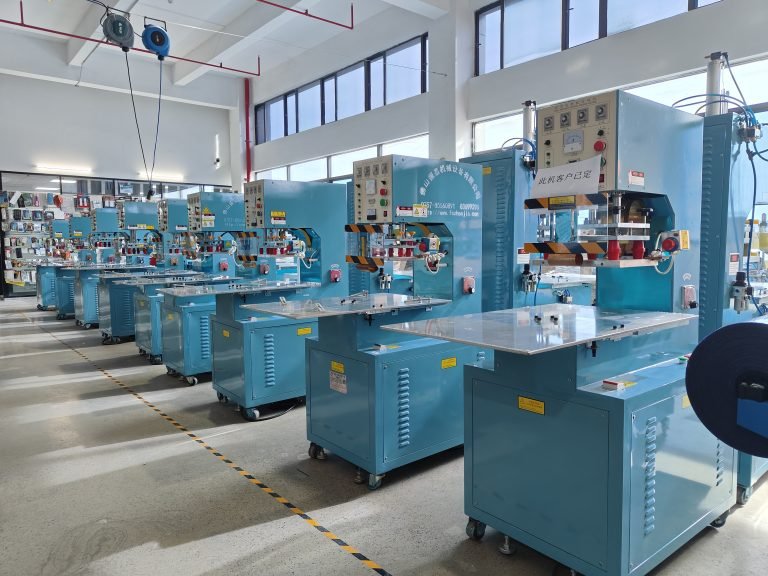
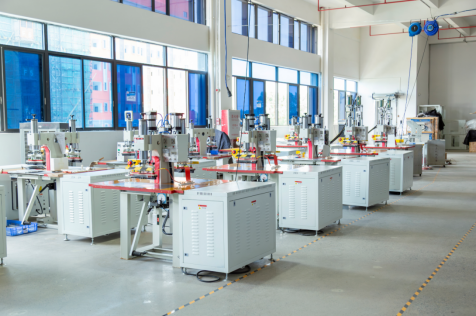
Foshan Zhenjia Machinery Co., Ltd. , for example, offers a comprehensive range of automatic high frequency welding machines for PVC tents, tarpaulins, and industrial applications, featuring PLC-controlled timers, digital displays, and integrated safety systems. With 100% on-time delivery and 100% reorder rates, they represent the engineering maturity found in Guangdong’s specialized manufacturing ecosystem .
6. Technical Specifications Comparison: What the Numbers Mean
6.1 Sample Specifications (Industrial-Grade HF Welder)
| Parameter | Typical Range | What It Means for You |
|---|---|---|
| Power | 5-30 kW | Higher power = faster heating, thicker materials |
| Frequency | 27.12 MHz | Standard ISM band, internationally accepted |
| Press Force | 5-30 tons | Determines maximum welding pressure |
| Welding Area | 300×400mm to 800×1200mm | Maximum product size per cycle |
| Cycle Time | 2-30 seconds | Production speed per weld |
6.2 High-Frequency Tube Mill Specifications Example
For metal pipe/tube production, specifications vary significantly by model :
| Model | Pipe OD | Wall Thickness | Max Speed | Main Motor | HF Welder |
|---|---|---|---|---|---|
| ZY-HF16 | 16mm | 0.3-1.0mm | 90 m/min | 22 kW | 60 kW |
| ZY-HF45 | 45mm | 0.6-2.0mm | 80 m/min | 90 kW | 150 kW |
| ZY-HF114 | 114mm | 1.5-4.0mm | 55 m/min | 160×2 kW | 300 kW |
| ZY-HF219 | 219mm | 2.0-8.0mm | 40 m/min | 250×2 kW | 600 kW |
7. Installation, Maintenance, and Troubleshooting
7.1 Installation Requirements
Proper installation is critical for long-term performance :
- Electrical: Stable power supply with correct voltage (220V/380V/415V) and adequate capacity
- Cooling: Clean, soft water with appropriate flow rate and pressure
- Compressed Air: Clean, dry air at specified pressure (typically 0.5-0.8 MPa)
- Flooring: Level, stable surface capable of supporting machine weight
- Ventilation: Adequate airflow to dissipate heat and ozone
7.2 Preventive Maintenance Schedule
Regular maintenance extends equipment life and ensures consistent quality :
| Frequency | Tasks |
|---|---|
| Daily | Clean work area, check electrodes, verify safety systems |
| Weekly | Clean interior components with soft brush/compressed air, check cooling water level |
| Monthly | Inspect electrical connections, lubricate moving parts, check filter conditions |
| Quarterly | Replace electrodes (if worn), test calibration, inspect cooling system |
| Annually | Comprehensive inspection, dielectric strength testing, professional service |
7.3 Common Problems and Solutions
Weak Welds or Poor Quality
| Possible Cause | Solution |
|---|---|
| Insufficient power | Increase power setting gradually |
| Incorrect welding time | Adjust based on material thickness |
| Dirty or worn electrodes | Clean with mild abrasive or replace |
| Low pressure | Check and adjust hydraulic/pneumatic pressure |
| Material contamination | Verify material cleanliness |
Overheating
| Possible Cause | Solution |
|---|---|
| Poor ventilation | Ensure adequate airflow, install additional fans |
| Continuous operation | Allow cooling time between cycles |
| Cooling system failure | Check pump, filters, water level |
| Blocked cooling lines | Flush system, clean filters |
No Output/Intermittent Output
| Possible Cause | Solution |
|---|---|
| Power supply issues | Check voltage, fuses, breakers |
| Oscillator tube failure | Test and replace if necessary |
| Protection circuit triggered | Identify cause (overheating, overcurrent), reset |
| Loose connections | Inspect and tighten all electrical connections |
Noise or Vibration
| Possible Cause | Solution |
|---|---|
| Loose mechanical parts | Tighten all fasteners |
| Bearing wear | Replace affected bearings |
| Foreign objects | Remove debris from moving parts |
8. Market Trends and Future Developments
8.1 Intelligent Control Systems
Modern automatic high frequency welding machines are becoming increasingly intelligent. New models feature advanced micro-control systems that automatically detect material type and thickness, then adjust welding power, time, and frequency in real-time for optimal results .
8.2 Industry 4.0 Integration
IoT connectivity enables predictive maintenance, remote diagnostics, and production data analytics. Manufacturers can monitor equipment performance, schedule maintenance proactively, and optimize production parameters based on real-time data .
8.3 Energy Efficiency Improvements
Ongoing developments in solid-state generator technology continue to improve energy efficiency, reducing operating costs and environmental impact. Next-generation machines incorporate advanced power management features that minimize standby consumption .
8.4 Emerging Market Growth
Emerging economies including India, Brazil, and Vietnam are experiencing rapid industrial growth, driving demand for high frequency welding machines in packaging, construction, and manufacturing. The market in these regions is projected to grow at 8-10% annually .
8.5 Sustainable Manufacturing
Increasing focus on sustainability is driving demand for:
- Energy-efficient equipment
- Machines compatible with recyclable and bio-based materials
- Reduced waste through precision control
9. Procurement Guide: 7 Steps to a Successful Purchase
Step 1: Define Your Requirements
- Material types and thicknesses
- Production volume (pieces per hour/day)
- Part size and welding area needed
- Available utilities (power, air, water)
- Budget (initial investment and operating costs)
Step 2: Research Potential Suppliers
- Verify technical capabilities and specialization
- Check customer reviews and industry reputation
- Review on-time delivery rates (look for ≥98%)
- Check reorder rates (≥25% indicates customer retention)
Step 3: Request Detailed Quotations
Include in your RFQ:
- Complete technical specifications
- List of included components and options
- Delivery terms and timeline
- Warranty and after-sales support
- Training and documentation
Step 4: Validate Technical Claims
- Request test videos showing actual weld cycles
- Ask for circuit diagrams and CE certificates
- Verify compliance with IEC 60204-1 safety standards
- Request dielectric strength testing reports
Step 5: Order Samples
For critical applications, consider:
- Testing with your actual materials
- Evaluating weld quality and cycle times
- Assessing ease of operation and adjustment
Step 6: Negotiate Terms
- Payment schedule (typically 30% deposit, 70% before shipment)
- Inspection rights before shipment
- Warranty period and coverage
- Spare parts availability commitment
- Installation and training support
Step 7: Plan for Delivery and Setup
- Prepare site according to supplier specifications
- Arrange for qualified personnel to receive training
- Stock initial spare parts (electrodes, fuses, etc.)
- Schedule installation and commissioning
10. Frequently Asked Questions (FAQ)
Q: What materials can be welded with high frequency?
A: High frequency welding works best with polar thermoplastics such as PVC, EVA, TPU, and PU (thickness range: 0.1-3.0 mm). Non-polar materials like HDPE, PP, and PTFE require alternative methods such as hot-air or extrusion welding due to their low dielectric loss factors .
Q: What is the difference between high frequency and ultrasonic welding?
A: High frequency welding uses electromagnetic energy at 27.12 MHz to heat materials throughout their thickness, while ultrasonic welding uses mechanical vibrations (20-40 kHz) to create friction heat at the joint interface. High frequency is generally faster for larger areas, while ultrasonic offers precision for small parts.
Q: How long do high frequency welding machines last?
A: With proper maintenance, industrial high frequency welding machines typically last 10-15 years or more. Key factors affecting lifespan include usage intensity, maintenance quality, and operating environment.
Q: What safety features should I look for?
A: Essential safety features include emergency stops, safety interlocks on moving parts, RF shielding to prevent radiation exposure, overcurrent protection, thermal protection, and compliance with relevant safety standards .
Q: Can I customize a machine for my specific application?
A: Yes, most manufacturers offer customization including special mold designs, specific table sizes, multi-station configurations, custom voltage options, and PLC programming for specific applications. Minimum order quantities for custom builds typically start at 1-5 units .
Q: What is the typical delivery lead time?
A: Standard models: 15-25 days after order confirmation. Custom configurations (special voltage, dual stations, PLC integration): 35-45 days .
Q: Do suppliers provide installation and training?
A: Most reputable suppliers offer remote video guidance for installation. On-site commissioning services are often available at additional cost. Comprehensive training and operation manuals should be included .
Conclusion: Making Your Investment Decision
Selecting the right automatic high frequency welding machine is a significant investment that impacts your production capabilities for years to come. By understanding the technology, evaluating your specific requirements, and carefully assessing suppliers, you can make a confident decision that delivers long-term value.
Key takeaways for your purchase decision:
✅ Match machine specifications to your actual production needs—overspending on capacity you don’t need wastes capital, while undersizing creates bottlenecks
✅ Prioritize suppliers with proven track records, technical expertise, and responsive support
✅ Verify claims through documentation, samples, and references
✅ Consider total cost of ownership, not just purchase price
✅ Plan for proper installation, maintenance, and operator training
[Foshan Zhenjia Machinery Co., Ltd.] offers a comprehensive range of automatic high frequency welding machines for PVC tarpaulins, tents, inflatable structures, and industrial applications. With 100% on-time delivery, 100% customer reorder rates, and engineering expertise backed by Guangdong’s specialized manufacturing ecosystem, we provide reliable solutions tailored to your production requirements .
Contact our engineering team today for a consultation on your specific application, or request a sample weld test to see the quality for yourself.
Last updated: March 2026